Key facts
- Taiwan is combining U.S. software and technology with traditional shipbuilding to create sea drones.
- The initiative aims to counter China's growing maritime capabilities and deter a potential invasion.
- Taiwan plans to introduce sea drones to its naval forces this year.
- Retired Adm. Dennis Blair believes sea drones could be adapted to prevent amphibious attacks.
- An exhibition in Taiwan featured U.S. companies like Ocean Aero and Auterion.
Taiwan is accelerating its development of naval drones, integrating U.S. software and technology with its shipbuilding expertise to counter China's expanding maritime fleet. This strategic shift aims to bolster the island's maritime security amid intensifying pressure from Beijing, which has not ruled out the use of force to seize the self-ruled island.
Defense Minister Wellington Koo told The Wall Street Journal that Taiwan plans to begin introducing sea drones to its naval forces this year, as part of preparations for a potential invasion by China. The success of sea drones used by Ukraine against Russia's naval superiority in the Black Sea offers a model for Taiwan to potentially establish supremacy in the Taiwan Strait and repel an amphibious assault.
Retired Adm. Dennis Blair, former head of the U.S. Pacific Command, suggested that Taiwan could adapt Ukraine's tactics to prevent amphibious ships from attacking. He believes that even with superior air power and missiles, smaller nations with imaginative tactics and available new systems can effectively stop opposing forces.
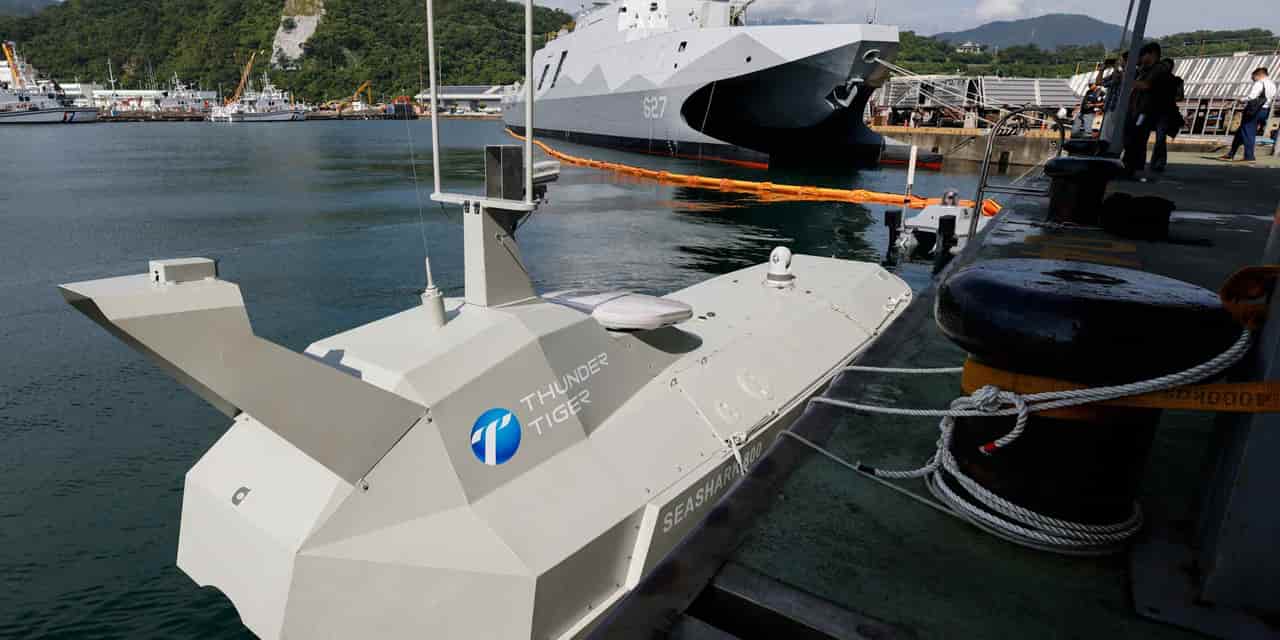
An exhibition on Taiwan's northeastern seacoast showcased cutting-edge sea drone technology from a dozen local and U.S. companies. Displays included Ocean Aero's autonomous surface vessel that can transform into a submarine and Auterion's artificial-intelligence-powered targeting system designed for drone swarms, which has been used in Ukraine. Taiwan-built drones also performed demonstrations of their agility.
Experts like Stacie Pettyjohn, a senior fellow at the Center for a New American Security, noted that swarms of these drone boats could be highly effective in challenging amphibious assaults, particularly given Taiwan's geography. Scott Savitz, a senior engineer at Rand Corp., highlighted that sea drones have applications beyond simply being explosive devices, citing uses in mine-clearing and port defense.
Taiwan faces challenges in building a domestic drone industry, particularly concerning cost and reliance on Chinese parts for aerial drones. For sea drones, the primary hurdle is cost, given Taiwan's relatively small market. Planners aim to stimulate local industry through government funding and contracts, with the U.S. providing technological expertise. Military research and development officials have indicated that future spending will include substantial procurement of sea drones, contingent on equipment performance.