Key facts
- Researchers created model papyrus scrolls with inks of varying lead concentrations.
- The model scrolls were charred to mimic the original Herculaneum scrolls.
- X-ray fluorescence scanners can identify scrolls with lead-based ink.
- Lead-based ink provides a stronger signal for X-ray imaging compared to carbon-based ink.
- The Vesuvius Challenge aims to decipher ancient, charred papyrus scrolls from Herculaneum.
A team of researchers has developed a method to improve the deciphering of ancient, charred papyrus scrolls by creating and analyzing contemporary model scrolls. The project, detailed in a new paper in PLoS ONE, focuses on identifying scrolls written with lead-based ink, which are more amenable to X-ray imaging techniques.
The Vesuvius Challenge, an ongoing initiative, aims to digitally unwrap and decipher hundreds of fragile scrolls excavated from a Roman residence in Herculaneum, which were carbonized by the 79 AD eruption of Mount Vesuvius. While some fragments have revealed philosophical texts, the majority remain unreadable due to their extreme fragility and the low contrast of carbon-based ink on papyrus.
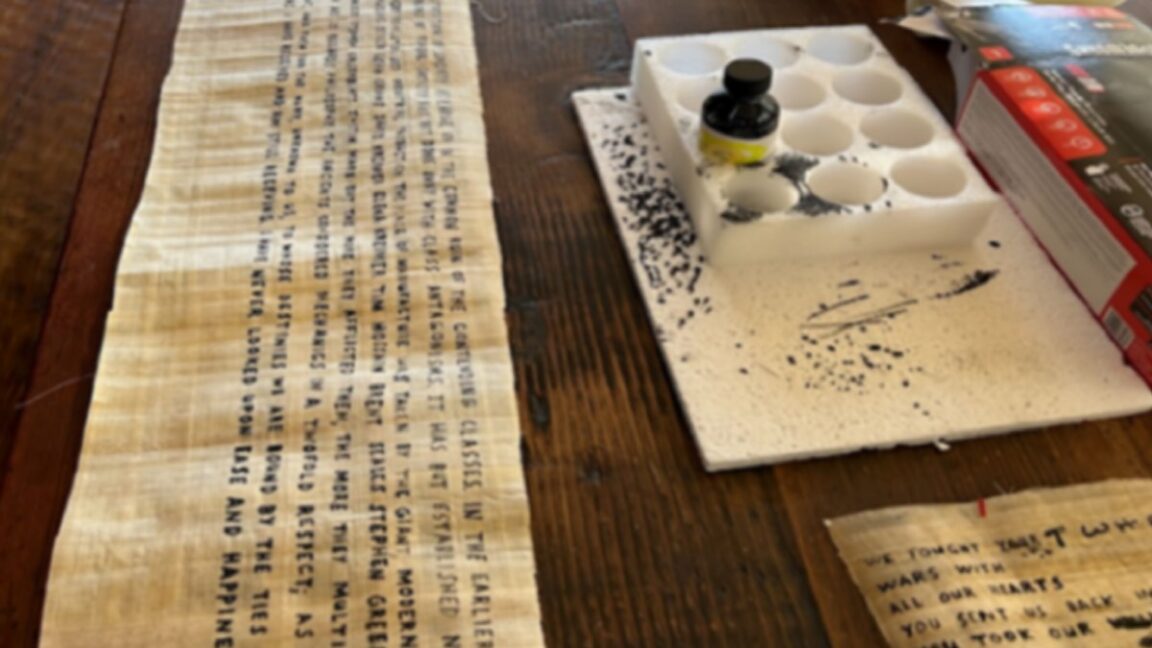
Douglas Seiler, a retired inventor, led an interdisciplinary team to address these challenges. They created model scrolls using modern Egyptian papyrus and traditional lampblack ink, to which they added varying amounts of lead nitrate. These model scrolls were inscribed with various texts, then carbonized to simulate the condition of the Herculaneum scrolls. Physicist Jake LaManna performed 3D X-ray scans on these charred models, and co-author Michael Cyrus Daugherty adapted software to digitally unroll the scanned images and reveal the text.
This new approach offers a significant advantage because lead-based ink fluoresces strongly under X-ray imaging, unlike carbon-based ink which has very low contrast against the papyrus. Seiler expressed confidence that focusing on scrolls with lead ink will greatly accelerate the deciphering process. Even a handheld X-ray fluorescence scanner is deemed sufficient to identify the most promising candidates for further analysis, potentially speeding up the painstaking work that has yielded some readable texts in recent years.