Key facts
- Chimpanzees teach their young tool use through deliberate transfer of implements.
- Adult chimps model tool use and then hand over tools to infants for practice.
- This social learning helps chimps acquire skills for accessing difficult-to-reach foods.
- Mothers are the main teachers, with most tool transfers occurring from mother to infant.
- The study analyzed 33 instances of tool transfer behavior in chimpanzees in Senegal.
- Ant-dipping was the most common context for tool transfer, followed by algae and termite fishing.
Chimpanzees deliberately teach their offspring how to use tools by demonstrating the behavior and then handing over the implements, according to a new study published in Frontiers in Psychology. This social learning process, particularly observed from mothers to their young, helps chimpanzees acquire complex skills necessary for accessing food sources that are otherwise difficult to obtain.
The research, conducted between 2017 and 2025 at the Dindefelo Community Nature Reserve in Senegal, analyzed nearly 15 hours of video footage from camera traps. The analysis revealed 33 instances of tool transfer behavior, with 58 percent occurring in the context of ant-dipping using twigs. Other observed activities included algae fishing and termite fishing.
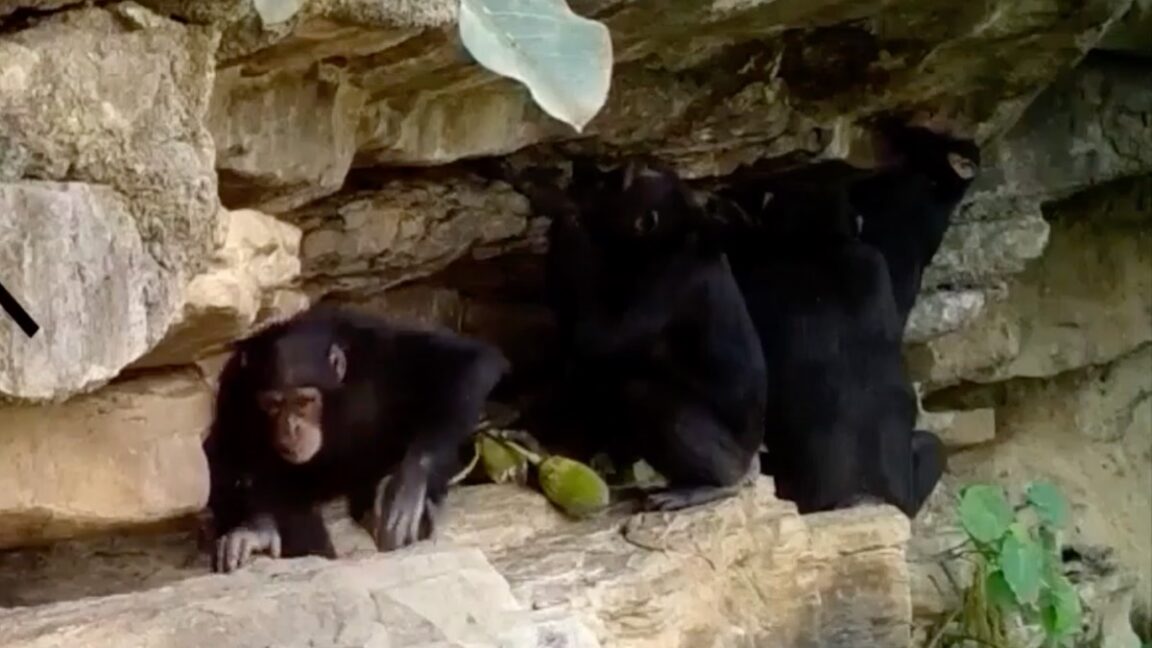
Most tool transfers involved adults, predominantly females, handing tools to infants. In many cases, the infant initiated the voluntary transfer. The study highlighted specific case studies, including an adult female named Soukki demonstrating ant-dipping to her infant Saïsaï, who later mimicked the behavior. Another instance involved a mother named Féré and her infant Fotti learning to crack baobab fruits with the help of a juvenile.
Co-author Andreu Sánchez-Megías stated that tool transfers appear to be a form of teaching, complementing observation and supervised practice. This behavior is thought to have evolved to transmit complex information that might be too difficult to acquire through simpler learning mechanisms.