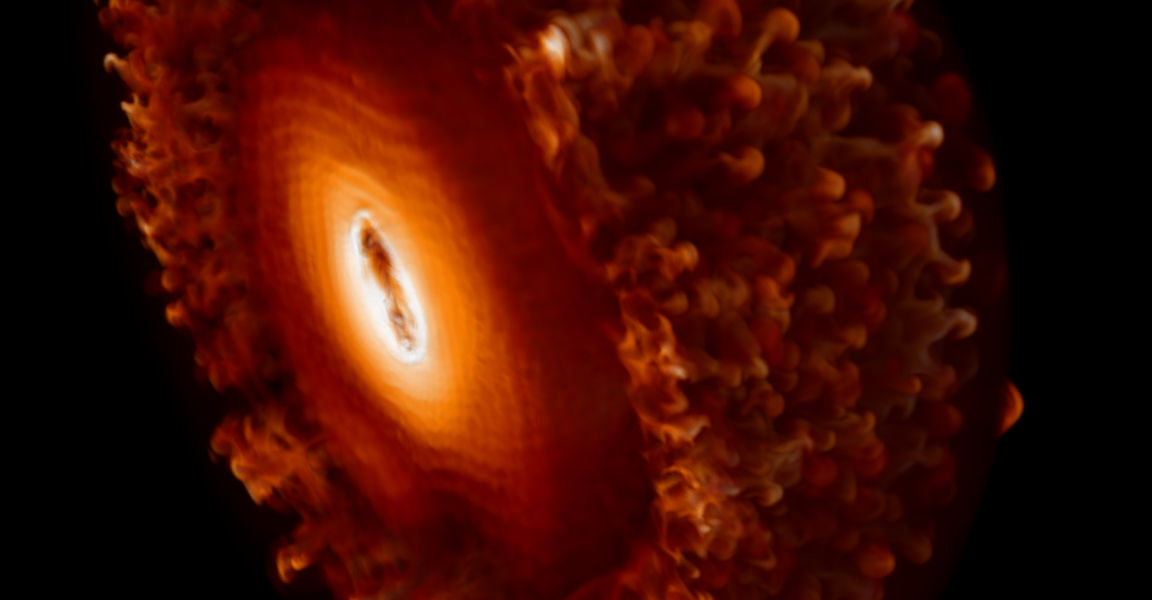
A new study published in Physical Review D proposes that the ability of neutrinos to change identities, known as flavor oscillation, could explain discrepancies in current models of core-collapse supernovae. While the general understanding is that massive stars collapse under gravity and then explode, observations suggest fewer supernovae occur than expected based on star formation rates. Additionally, the number of red supergiants observed doesn't align with their expected contribution to supernovae.
Neutrinos are crucial in existing supernova models, mediating energy transfer that helps the shockwave escape the collapsing core. However, these models typically do not account for neutrino flavor oscillation, where neutrinos can shift between their three types (electron, muon, and tau). This oscillation can alter how neutrinos interact with matter, influencing the heating and cooling processes behind the shockwave.
The researchers, Mariam Gogilashvili and Irene Tamborra, used a simplified model where flavor changes occur almost instantaneously and energy is evenly distributed among all six neutrino types. They simulated the collapse of nearly 200 stars with masses ranging from nine to 120 times that of the Sun. Their findings indicate that flavor oscillations tend to distribute more energy into heavier neutrinos, which can reduce the energy transferred to the shockwave. In some cases, this can cause the shockwave to stall, leading to the direct collapse of the star into a black hole rather than a supernova explosion.
This effect is particularly pronounced in stars with masses around 15 to 30 solar masses, potentially explaining the observed scarcity of supernovae from red supergiants. The study also notes that the rate of failed supernovae could significantly increase depending on the density cutoff used to define the shockwave. Furthermore, if a supernova fails to occur, more stellar material would end up on the remnant, resulting in larger black holes.