Key facts
- POET supplied 100% bioethanol for the first U.S. marine bunkering operation.
- The trial involved A.P. Moller - Maersk and took place in Houston.
- Bioethanol is presented as a scalable, low-carbon fuel option for the maritime industry.
- POET produces over 3 billion gallons of bioethanol annually across 35 facilities.
- Existing methanol-capable dual-fuel marine engines can operate on ethanol with minimal modification.
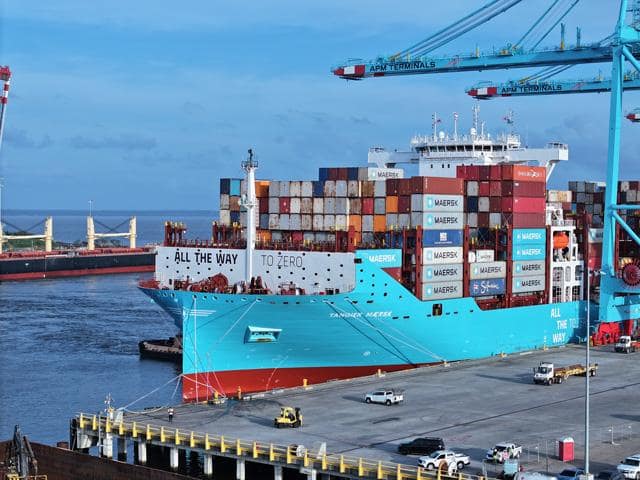
POET, the world's largest bioethanol producer, has supplied plant-based bioethanol for the first 100% bioethanol bunkering operation in the United States. The trial, conducted in Houston with A.P. Moller - Maersk, a major global shipping company, signifies a potential advancement for bioethanol as a marine fuel.
The operation, which successfully bunkered a vessel with 100% bioethanol, builds upon Maersk's prior testing of the fuel in its dual-fuel fleet. Bioethanol is being positioned as a low-carbon-intensity fuel option that can utilize existing global fuel and supply infrastructure.
Jeff Broin, Founder and CEO of POET, highlighted the significance of American-made bioethanol moving from farms to container ships, describing it as an abundant, affordable, and clean option for the marine sector. The initiative was a collaborative effort involving Maersk, Kirby Corporation for bunkering and transportation, the Port of Houston for infrastructure, and the U.S. Coast Guard for regulatory support.
Emma Mazhari, Maersk's Vice President of Energy Markets, stated that bioethanol has the potential to contribute to the shipping industry's future energy mix, offering a scalable, lower-emission fuel and greater flexibility in the transition to lower-carbon fuels. This operation is seen as an important step in integrating bioethanol into U.S. marine fuel supply chains.
POET, as the 11th-largest U.S. container exporter, connects American agriculture to global commerce. The company produces over 3 billion gallons of bioethanol annually across its 35 bioprocessing facilities, supported by established production, transportation, and distribution infrastructure.
A recent report by Growth Energy suggests that ethanol is technically ready for commercial shipping and could represent a significant new market. The report noted that existing methanol-capable dual-fuel marine engines can operate on ethanol with minimal modifications. However, challenges for ethanol adoption include the need for dedicated fueling infrastructure, fuel-quality specifications, and competition from other low-carbon fuels like methanol, ammonia, and renewable diesel.