Key facts
- Nvidia is developing a full-stack safety system for physical AI technologies like robotics and self-driving cars.
- The Nvidia Halos system, launched in 2025 for AVs and expanded to robotics in June 2026, aims to prevent machines from harming people.
- Nvidia's physical AI business is already driving nearly $10 billion in annual revenue.
- The Halos system includes hardware like the Nvidia IGX Thor computing module and software for constant monitoring and isolation of safety-critical workloads.
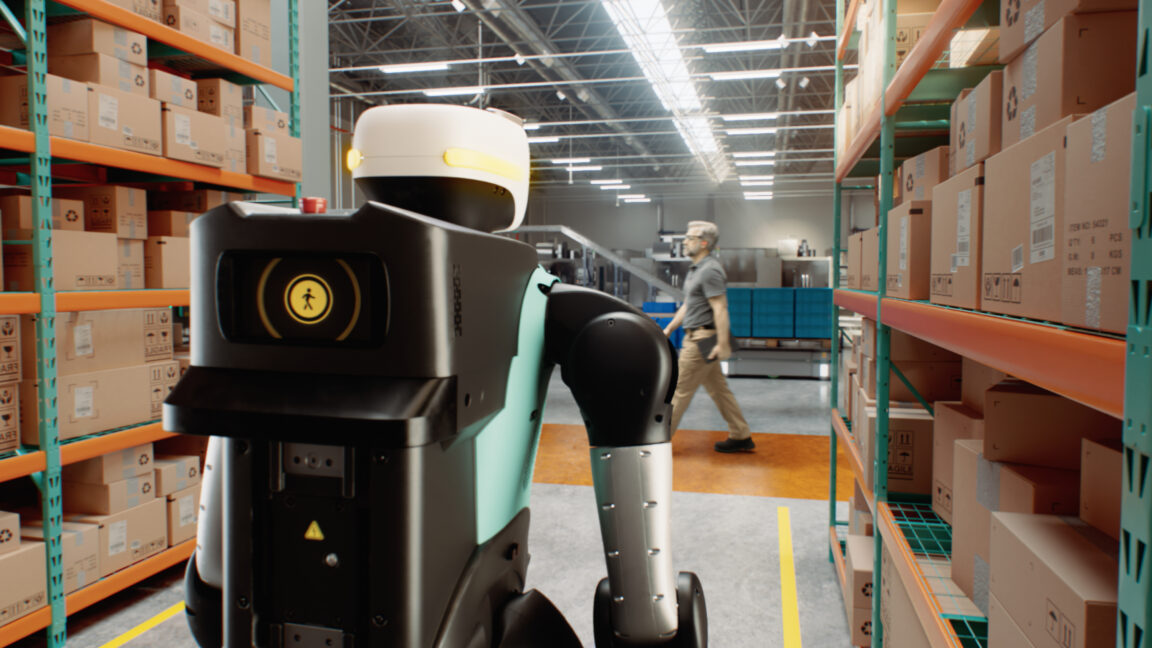
- Agility Robotics' Digit humanoid robot and Boston Dynamics' Spot, Stretch, and Atlas robots are among those incorporating Nvidia's safety system.
- KION Group and LG are also working with Nvidia Halos.
Nvidia is expanding its focus on physical AI beyond data centers by developing and deploying a comprehensive safety system called Halos. This system is designed to ensure that robots and autonomous vehicles can operate safely around people.
The Halos system, initially launched in 2025 with hardware and software tools for self-driving cars, was extended to more physical AI applications with the announcement of Nvidia Halos for Robotics in June 2026. The goal is to enable the safe deployment of autonomous mobile robots in warehouses, humanoid robots in factories, and even surgical robots.
Nvidia CEO Jensen Huang highlighted the physical AI business as a significant growth area, contributing nearly $10 billion in annual revenue as of March 2026. He had previously identified it as Nvidia's second-most important growth category in 2025.
The full-stack safety system involves hardware, such as the Nvidia IGX Thor computing module for robotics, which includes a dedicated processor for safety workloads. The software component, the Halos operating system, is designed for continuous monitoring of hardware and software to detect failures and isolate critical computing tasks. The system also incorporates the Nvidia Holoscan Sensor Bridge to process sensor data and identify corrupted inputs, along with simulation tools for virtual testing and an inspection lab program for partner feedback.
Adapting the safety system from autonomous vehicles to robotics required addressing diverse safety definitions, as robotic applications vary widely. Nvidia aimed to create a programmable platform that allows developers to define custom safety functions without compromising the underlying infrastructure.
Several companies are already integrating Nvidia Halos. Agility Robotics has incorporated the system into its Digit 5 humanoid robot, allowing it to operate without isolated workstations. Boston Dynamics is also a partner, focusing on safety accreditation for its Spot, Stretch, and Atlas robots. Other partners include KION Group, which deploys autonomous forklifts, and LG, which is developing a humanoid robot using Nvidia's Isaac GROOT foundation model.