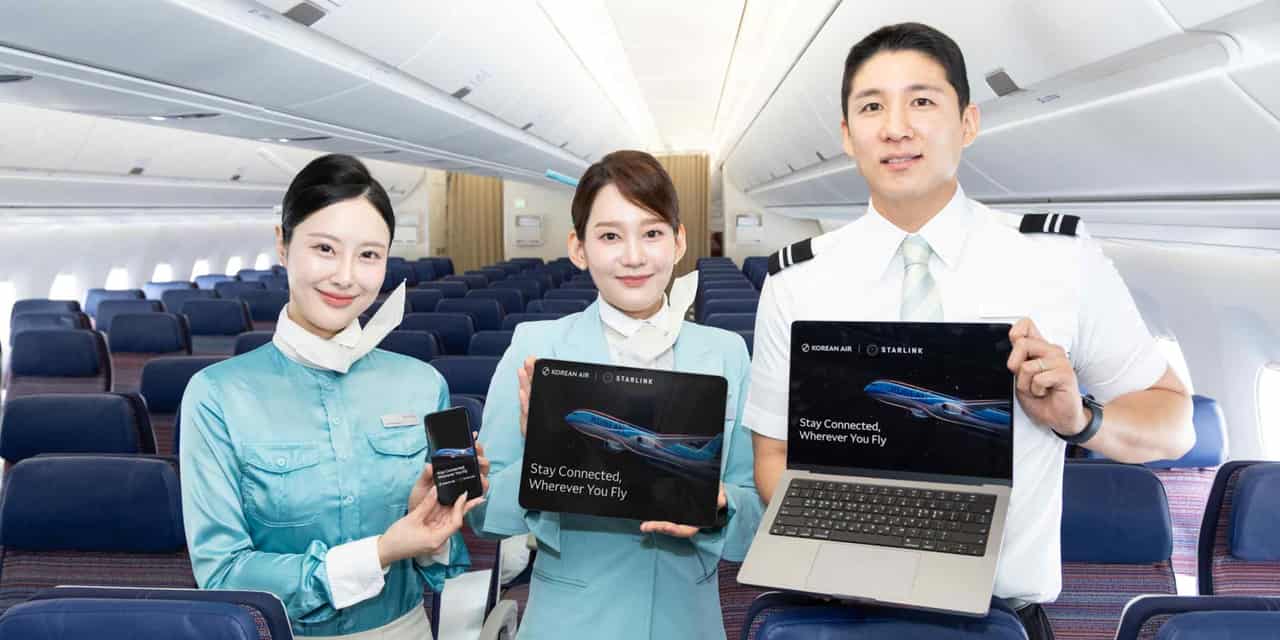
Korean Air, South Korea's top carrier, is launching free in-flight Wi-Fi powered by SpaceX's Starlink on select flights starting September 15. The service aims to provide seamless streaming, gaming, and browsing at 35,000 feet, making Korean Air the first full-service carrier in East Asia to adopt the technology.
Key Numbers
35,000 feetaltitude for seamless streaming, gaming, and browsing
4 aircraftinitial phase of Korean Air's Starlink Wi-Fi rollout
2027by end of year for fleet-wide expansion of Korean Air's service
10 aircraftinitial phase of Asiana Airlines' Starlink Wi-Fi rollout
Who's Involved
Korean Air
South Korea's top carrier launching free Starlink in-flight Wi-Fi
SpaceX
provider of Starlink satellite communication system for in-flight Wi-Fi
Asiana Airlines
airline also launching free Starlink Wi-Fi ahead of merger
↳ Why This Matters
The adoption of Starlink by major airlines like Korean Air and Asiana Airlines signals a significant shift in in-flight connectivity, offering passengers high-speed internet for entertainment and productivity at no extra cost, potentially setting a new industry standard.
Key facts
Korean Air is offering free in-flight Wi-Fi powered by SpaceX's Starlink.
The service is available on select flights starting September 15, 2026.
Korean Air is the first full-service carrier in East Asia to adopt Starlink's satellite communication system.
The initial phase covers four aircraft: three Airbus A350-900s and one Boeing 777-300ER.
The service will be expanded to most of Korean Air's fleet by the end of 2027.
Asiana Airlines is also launching free Starlink Wi-Fi on 10 aircraft ahead of their merger.
Korean Air, South Korea's top airline, is set to offer complimentary in-flight Wi-Fi powered by SpaceX's Starlink satellite internet service starting September 15, 2026. This initiative positions Korean Air as the first full-service airline in East Asia to adopt this advanced connectivity solution, aiming to enhance the passenger experience with seamless streaming, gaming, and browsing at cruising altitudes.
The initial deployment will feature the Starlink system on four aircraft: three Airbus A350-900s and one Boeing 777-300ER. These planes will primarily operate on long-haul routes connecting to destinations in the Americas, Europe, and Southeast Asia. Korean Air has plans to extend this high-speed internet service to the majority of its active fleet by the close of 2027.
Unlike older satellite Wi-Fi systems that suffered from high latency, Starlink's low-Earth orbit (LEO) satellites significantly reduce signal delay. This allows for smooth over-the-top (OTT) video streaming, music playback, and online gaming. The service is free for passengers in all seating classes. To access it, travelers need to connect to the network via their devices, input boarding pass details, and watch a short advertisement, with no separate membership required.
In parallel, Asiana Airlines, which is preparing to merge with Korean Air, is also introducing free Starlink Wi-Fi. Asiana will initially equip 10 aircraft—nine Airbus A350-900s and one A330-300—with the technology before a broader rollout across its fleet.
Frequently asked questions
Starlink Wi-Fi is an in-flight internet service powered by SpaceX's low-Earth orbit satellite constellation, designed to provide high-speed, low-latency internet connectivity to aircraft.
Passengers can connect by switching their devices to airplane mode, connecting to the Starlink network, entering their boarding pass details, and watching a short advertisement.
The initial phase covers flights operating primarily on long-haul routes to the Americas, Europe, and Southeast Asia.
What Happens Next
01Korean Air plans to expand Starlink Wi-Fi service to most of its active fleet by the end of 2027.
02Asiana Airlines will roll out Starlink Wi-Fi across the rest of its fleet after initial equipping of 10 aircraft.
How It Developed
Korean Air began offering free in-flight Wi-Fi powered by SpaceX's Starlink on select flights on Tuesday, September 15, 2026.
Asiana Airlines is also launching free Starlink Wi-Fi, initially equipping 10 aircraft.