Key facts
- South Korea's Nuri rocket will launch 15 satellites on October 7.
- Five of the satellites will form the country's first domestically launched microsatellite constellation.
- The launch is scheduled from the Naro Space Center between 12:23 p.m. and 1:23 p.m.
- The payload includes five New-space Earth Observation Satellite Constellation for National Safety (NEONSAT) satellites and 10 CubeSats.
- The NEONSAT constellation will eventually consist of 10 satellites operating in two orbital planes.
- The constellation will be able to image the Korean Peninsula more than three times a day.
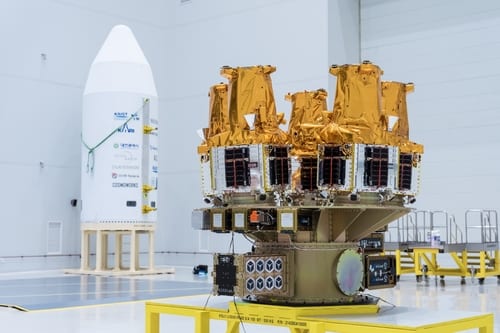
South Korea's homegrown Nuri rocket is scheduled for its fifth launch on October 7, carrying 15 satellites including five that will establish the nation's first domestically launched microsatellite constellation. The launch, set to occur between 12:23 p.m. and 1:23 p.m. from the Naro Space Center in Goheung, marks a significant step in the country's satellite development.
The payload comprises five New-space Earth Observation Satellite Constellation for National Safety (NEONSAT) satellites, weighing approximately 500 kilograms combined, and 10 CubeSats weighing about 96 kilograms. This mission represents Nuri's first attempt to deploy multiple satellites performing the same mission sequentially into orbit, with the NEONSATs to be released in different directions to prevent collisions.
Park Jae-sung, head of KASA's space transportation division, stated that the launch will be a turning point for South Korea's satellite development, advancing toward mass production and constellation operations. Each NEONSAT is equipped with an electro-optical camera for national security and disaster response, such as monitoring wildfires and floods. The full NEONSAT constellation will eventually comprise 10 satellites, with the remaining five scheduled for launch in 2027. Once operational, the constellation is designed to image the Korean Peninsula more than three times daily and revisit locations within 24 hours.
Preparations are proceeding as planned, with satellites mounted on Nuri's upper stage and final assembly expected by the end of the month. Last inspections are slated for October 5, followed by the rocket's move to the launchpad on October 6.