
Key facts
- Venus's lower haze is formed by cosmic dust particles from meteorites interacting with sulfuric acid.
- Researchers at Tohoku University used a microphysical model to determine the haze's origin.
- The haze particles act as condensation nuclei, promoting cloud formation in Venus's main cloud deck.
- Iron compounds within the cosmic dust are confirmed to absorb ultraviolet rays in Venus's atmosphere.
- The findings suggest cosmic dust plays a crucial role in planetary climates, including those of exoplanets.
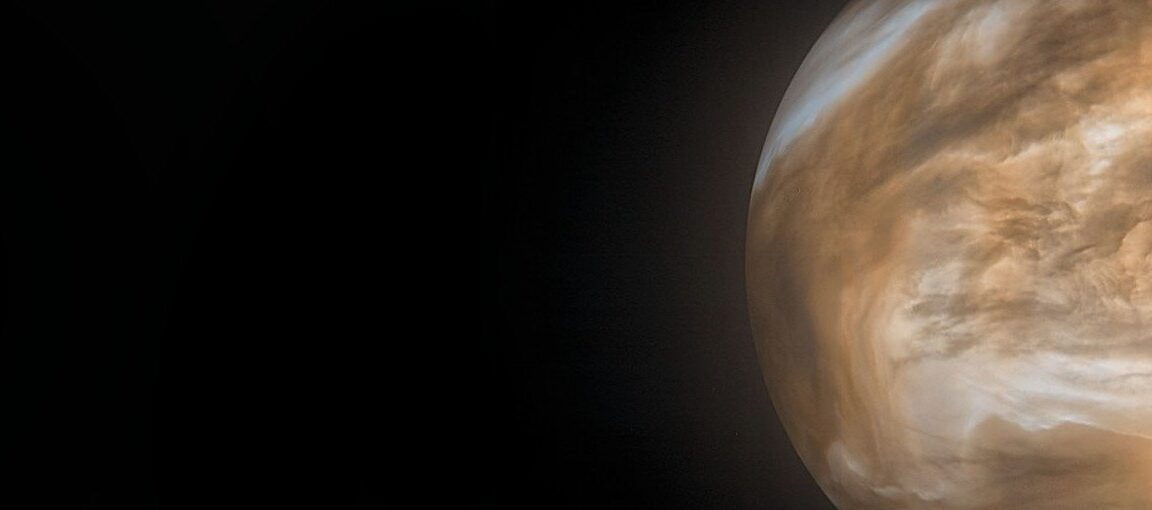
The long-standing mystery of Venus's yellowish lower haze has been solved by a team of planetary scientists at Tohoku University in Japan. Using a microphysical model, researchers have determined that the haze is not formed from volcanic ash or surface dust, as previously speculated, but rather from cosmic dust particles originating from meteorites.
When meteorites burn up in Venus's atmosphere, they leave behind dust particles. These particles then interact with sulfuric acid in the atmosphere, leading to the formation of the haze. According to planetary scientist Hiroki Karyu, the continuous influx of cosmic dust is sufficient to sustain this lower haze layer with the observed particle size distribution. These haze particles also act as efficient condensation nuclei, promoting cloud formation in the planet's main cloud deck.
The research also confirms that iron compounds found in meteorites are responsible for absorbing ultraviolet rays in Venus's atmosphere, a phenomenon that had puzzled scientists for decades. The study, published in Nature Astronomy, suggests that cosmic dust is an essential component of planetary climates, with implications for understanding haze formation on other planets, including gas giants and exoplanets.