
Key facts
- The LUX-ZEPLIN detector may have detected a hint of dark matter.
- The signal from LUX-ZEPLIN is below the threshold for discovery and could be a statistical fluke.
A monthly roundup of intriguing scientific discoveries includes a potential hint of dark matter from the LUX-ZEPLIN detector, observed entanglement in Z bosons at the Large Hadron Collider, a new method for 3D-printing Martian homes using yeast, and evidence of Ice Age psychoactive substance use.
These scientific advancements offer potential breakthroughs in fundamental physics, space exploration, and our understanding of human history, with implications for future technologies and the search for extraterrestrial life.
A monthly roundup of scientific discoveries highlights several intriguing stories that might have otherwise been overlooked. Among these are potential early signs of dark matter detected by the LUX-ZEPLIN experiment, the observation of quantum entanglement in Z bosons at the Large Hadron Collider, a novel approach to constructing habitats on Mars using a mixture of Martian rocks, gelatin, and yeast, and new evidence suggesting the use of psychoactive substances by humans during the Late Pleistocene era.
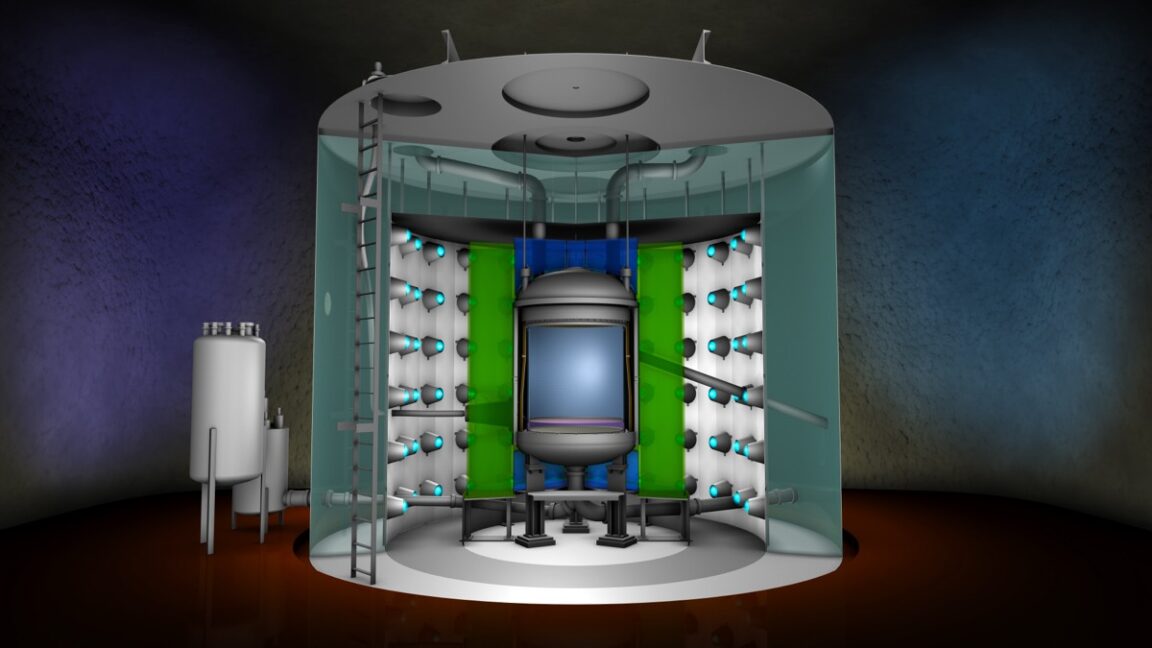
The LUX-ZEPLIN detector, located in a South Dakota gold mine, has reported a "hint" of dark matter, a finding presented at the 2026 TeV Particle Astrophysics conference. Physicists believe dark matter constitutes about 85 percent of the universe's matter, with weakly interacting massive particles (WIMPs) being a leading candidate. However, the signal is currently below the threshold for a confirmed discovery and may be a statistical anomaly. The LUX-ZEPLIN team is continuing to collect data, as are other detectors like XENONnT and China's PandaX. The observed event's higher-than-expected nuclear recoil energy has prompted theoretical physicists to explore alternative models for dark matter interactions.
In the realm of quantum physics, physicists at the Large Hadron Collider's ATLAS experiment have observed entanglement in pairs of Z bosons. This phenomenon, described by physicist N. David Mermin as "the closest thing we have to magic," is crucial for quantum computing and advanced sensors. Z bosons, which are short-lived particles produced from Higgs boson decays, were analyzed through their decay patterns into electrons and muons. The ATLAS detector's precise tracking allowed researchers to infer the spins of the original Z bosons, marking this as the highest-energy example of entanglement observed to date.
Addressing the challenge of housing on Mars, engineers from Hong Kong University of Science and Technology have developed a method for 3D-printing durable building materials. Their recipe combines simulated Martian rocks with terrestrial gelatin and yeast, creating a material that hardens into a structure comparable to concrete. Co-author Jishen Qiu was inspired by freeze-dried foods, noting the similarity between Martian environmental conditions and freeze-drying. The mixture, containing a special yeast coated with sticky proteins, forms a porous foam with a compressive strength of 10 to 12 megapascals, deemed sufficient for constructing one- or two-story structures on Earth and potentially higher on Mars due to its lower gravity. This method is considered less energy-intensive than melting Martian rocks and allows for the recycling of yeast for future construction.
Finally, new archaeological findings suggest that humans in the Late Pleistocene period may have utilized psychoactive substances. While evidence of hallucinogen use exists from later periods, such as the Neolithic, this research points to earlier practices. This adds to a growing body of evidence about the historical use of such substances in various cultural and ritualistic contexts across different ancient civilizations.
Pick the topics you care about. Get only what matters, on your cadence.