Key facts
- Toyota plans to invest $6.42 billion annually starting in 2028 to upgrade factories with robots.
- The company aims to deploy 400,000 robots across its facilities.
- Toyota executive Hiroki Nakajima stated the goal is for robots to coexist with humans, not replace them.
- Toyota's ELEY robot is a humanoid robot on wheels designed to learn tasks from human workers.
- Automakers are increasingly deploying humanoid robots for general-purpose tasks beyond specialized industrial robots.
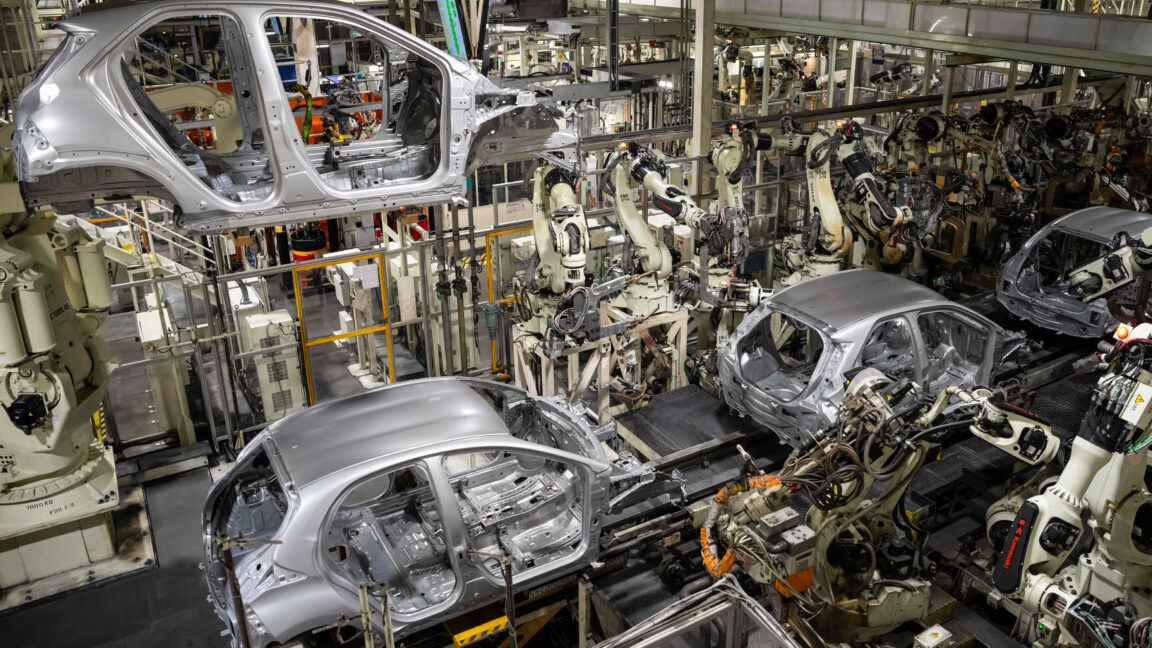
Toyota is planning a significant expansion of its robotic workforce, aiming to deploy 400,000 factory robots across its operations starting in 2028. The automaker intends to invest $6.42 billion annually in this initiative, with 150,000 robots slated for its own automotive plants and an additional 250,000 for group company facilities that produce components and materials.
While the company has already begun deploying its ELEY humanoid robots to learn from human workers on assembly lines, a Toyota executive emphasized that the goal is coexistence rather than replacement. Hiroki Nakajima, a Toyota executive vice president, told Nikkei Asia that the company envisions a future where robots and humans work together.
The automotive industry has a long history of adopting industrial robots, but the trend toward humanoid robots represents a more recent development. Companies are betting that these robots can become versatile, autonomous machines capable of performing various tasks and easily integrating into human-designed workplaces. However, significant challenges remain in AI, hardware, safety, and cost-effectiveness before widespread deployment of humanoid robots becomes feasible.
Other automakers are also investing in humanoid robot technology. Chinese electric vehicle makers like Xpeng and Nio are developing their own versions, while Hyundai plans to deploy Boston Dynamics' Atlas robots in its plants starting in 2028. Boston Dynamics recently opened a new robotics training center at Hyundai's electric vehicle facility in Georgia to train Atlas robots for automotive assembly tasks.