Key facts
- Japan is developing physical AI by assigning individual IDs to factory equipment to gather information across manufacturers.
- The government is funding factory-data preparation and robotics foundation models.
- NVIDIA is supplying compute, networking, model, simulation, and deployment stacks for Japan's physical AI strategy.
- Japan's physical AI strategy aims to develop systems that understand the real world's spatial structure and physical laws.
- A joint data collection center operated by Tsumura and four other companies is collecting movement data from robots mimicking human operators.
- The initiative seeks to develop AI systems capable of autonomous decision-making and robot operation in real-world environments.
Japan is embarking on a significant initiative to develop "physical AI," a form of artificial intelligence that enables robots to autonomously control machinery and perform tasks in the real world. The government, in collaboration with leading industrial machinery makers, plans to assign unique identification numbers to individual pieces of factory equipment. This will allow for the systematic collection of operational data across various manufacturers, which will then be used to train machine learning models.
The strategy, which entered an execution phase in 2026 and runs through 2030, is being supported by government funding for data preparation and the development of robotics foundation models. NVIDIA is a key partner, providing essential infrastructure including compute, networking, and simulation stacks. The initiative aims to leverage Japan's extensive history of high-quality manufacturing data to gain a competitive edge in the global AI race.
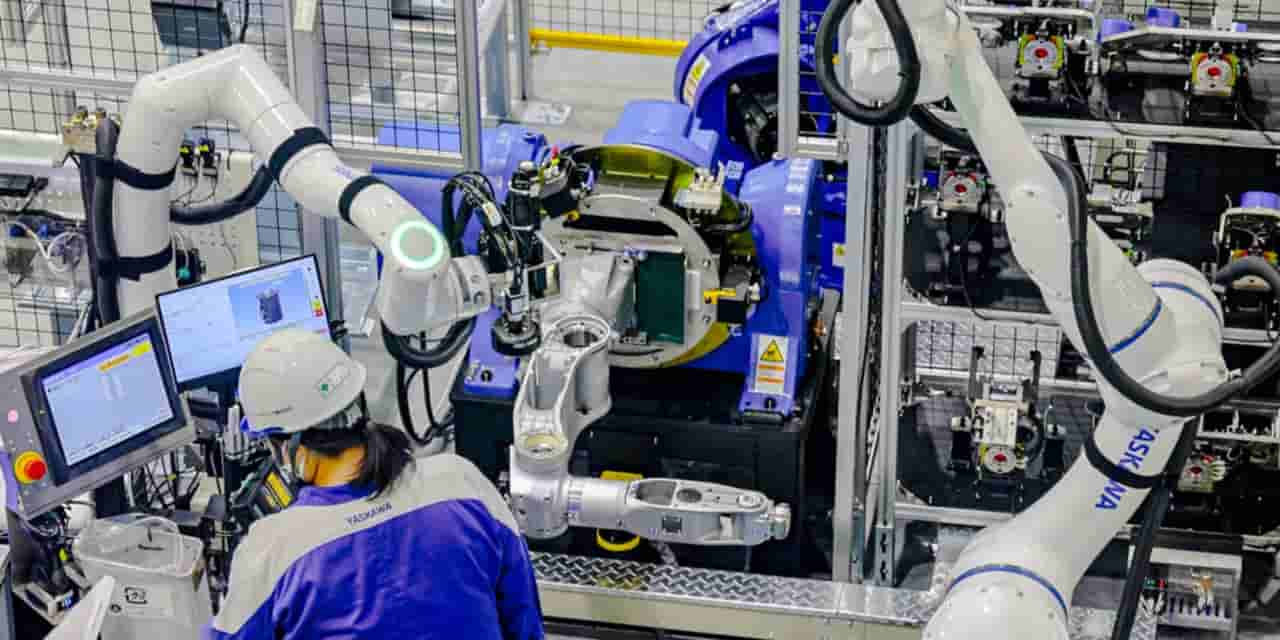
Companies like Yaskawa Electric are expected to benefit from this push. A joint data collection center, launched by pharmaceutical company Tsumura and four other firms, is already operational. At this center, robots are programmed to replicate human movements, with cameras recording the process to gather data for developing AI systems capable of autonomous decision-making and operation in existing factory environments. This approach is seen as cost-effective for integrating robots into current production lines designed for human workers.
Japan's Ministry of Economy, Trade and Industry (METI) has identified data protection and energy efficiency as key national constraints, driving the design of AI models toward local control and lower power consumption. METI and the New Energy and Industrial Technology Development Organization (NEDO) have selected nine projects for manufacturing data usability and two for robotics foundation models. The urgency is amplified by Japan's declining population, increasing the need for automation to maintain production capacity. The government views this data accumulation and practical application development as a way to maintain global competitiveness in physical AI.