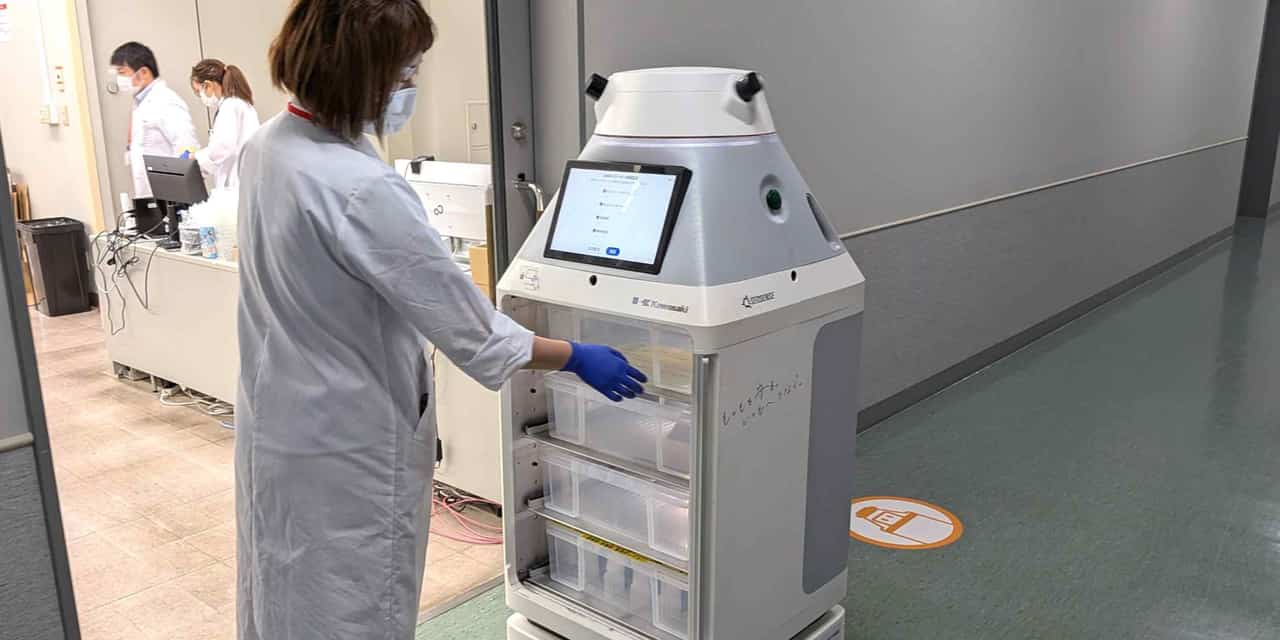
Kawasaki Heavy Industries has commenced mass production of robots designed to transport medical samples and medications within hospitals, a move aimed at addressing Japan's critical healthcare labor shortage. The company is working with Fujitsu to integrate these robots with existing hospital business systems, such as electronic medical records, to facilitate autonomous task execution. This collaboration seeks to provide innovative solutions for the healthcare sector, which is grappling with an aging population and a scarcity of workers.
Kawasaki's Forro robot is specifically designed for in-hospital transport. The company's initiative with Fujitsu involves developing software and hardware interfaces to create a common platform for linking robots, equipment, and AI, enabling advanced autonomous control. This platform aims to integrate with various robots and equipment, paving the way for more sophisticated AI-driven operations.
To bolster international collaboration in AI and semiconductors, Kawasaki established the 'Kawasaki Physical AI Center San Jose' in Silicon Valley in May 2026. The company is actively partnering with leading global entities including Fujitsu, NVIDIA, Microsoft, and Analog Devices, as well as academic institutions. Kawasaki also intends to join the NVIDIA Cosmos Coalition to advance open world models, which will assist Japanese companies in testing and optimizing physical AI systems before deployment across various industries, including healthcare.
What Happens Next
01Kawasaki and Fujitsu will conduct a business study aimed at providing new solutions that integrate hospital business systems with robot systems and AI.
02Fujitsu aims to make its common platform widely available, contributing to the social implementation of physical AI across industries.
03Kawasaki aims to establish a 'hospital one-stop solution' that covers the entire in-hospital experience.