Key facts
- Iranian President Masoud Pezeshkian stated Gaza symbolizes the failure of international mechanisms to prevent civilian suffering.
- Pezeshkian accused US President Donald Trump of having a 'bullying mentality'.
- Pezeshkian vowed Iran would not bend the knee to America but signaled readiness for dialogue.
- Iran's foreign minister and a US special envoy held a three-hour meeting on the sidelines of the UN General Assembly.
- Iran has set seven preconditions for returning to talks, including an end to the war and cessation of US aggressive actions.
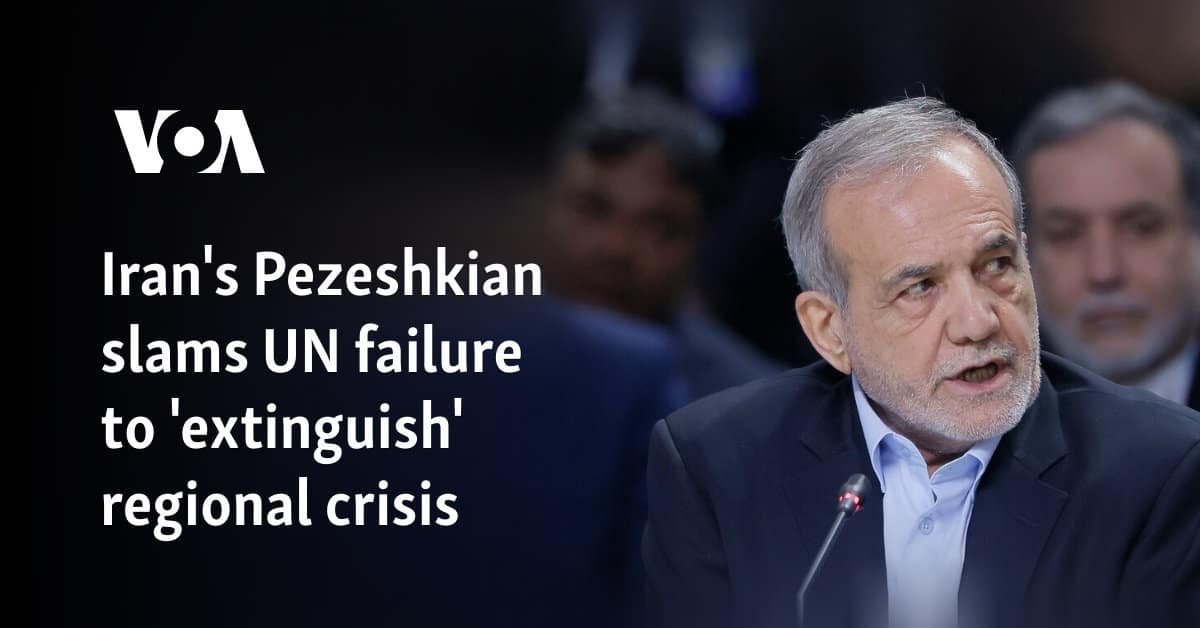
Iranian President Masoud Pezeshkian, in a speech to the UN General Assembly, stated that Gaza serves as a symbol of the failure of international mechanisms to prevent civilian suffering. He also criticized US President Donald Trump, labeling America as the true bully and terrorist in the Middle East and vowing that Iran would not yield to such pressure. Pezeshkian balanced this defiance with a willingness to engage in dialogue and diplomacy, provided it was not conducted under duress.
A three-hour meeting between Iran's Foreign Minister Abbas Araghchi and US Special Envoy Steve Witkoff on the sidelines of the assembly was described as constructive by both sides, marking the first such encounter since June. Pezeshkian indicated a focus on securing support from Iran's Arab neighbors for Tehran's proposals concerning the Strait of Hormuz, emphasizing Iran's inability to tolerate the passage of arms that could be used against it.
Pezeshkian accused Washington of 'terrorism' for the assassination of Iran's former supreme leader, Ayatollah Ali Khamenei, and presented photographs of Khamenei and schoolchildren killed in the conflict's early days, asserting that Iran had never initiated a war. He also defended Iran's right to a peaceful nuclear program and argued for regional security agreements independent of external powers like the US.
Iran's foreign ministry spokesperson, Esmail Baghaei, confirmed the talks, stating they were mediated by Qatar and aimed at conveying Iran's conditions, including an end to the war and the cessation of US aggressive actions. Iran has reportedly set seven preconditions for returning to negotiations, with the potential reopening of the Strait of Hormuz contingent on their fulfillment within seven days. The country's civilian aircraft are facing potential grounding due to the threat of US secondary sanctions, with Oman and Iraq reportedly closing their airspace to Iranian civilian planes.