Key facts
- ENN Group achieved high-parameter hydrogen-boron plasma control.
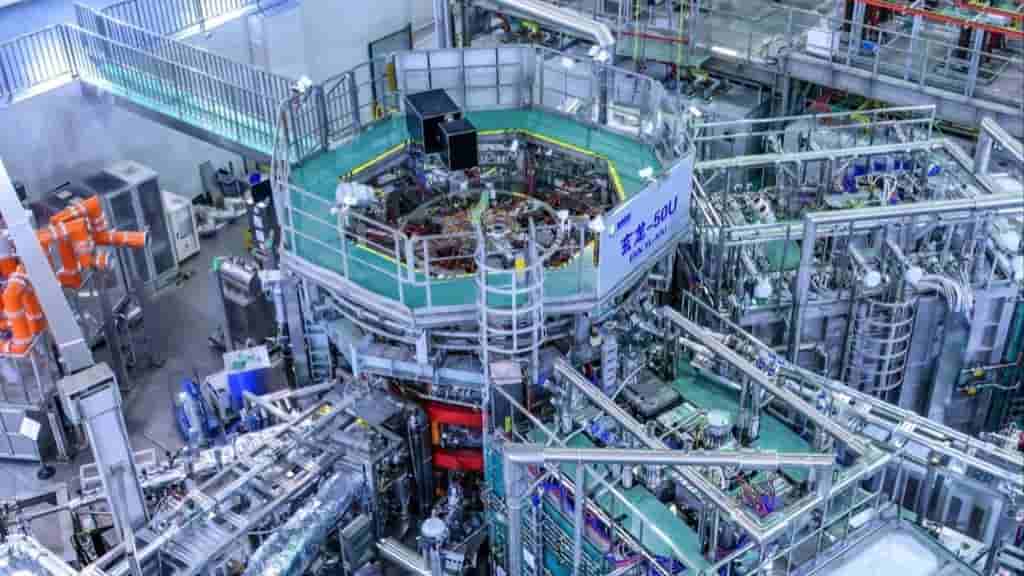
ENN Group announced it achieved high-parameter hydrogen-boron plasma control, a significant advance in neutron-free magnetic confinement fusion research. The company's EXL-50U spherical device successfully produced hydrogen-boron fusion reactions, a milestone in its commercialization strategy.
The successful demonstration of hydrogen-boron fusion by ENN Group could pave the way for a cleaner, more abundant energy source. This neutron-free approach offers potential advantages in safety and cost compared to traditional deuterium-tritium fusion, which could accelerate the commercialization of fusion power.
ENN Group, a Chinese company based in Langfang, Hebei province, announced on Monday that its EXL-50U spherical device has successfully achieved hydrogen-boron fusion reactions, marking a significant advance in neutron-free magnetic confinement fusion research. This achievement is part of ENN's broader strategy to commercialize fusion energy.
The company broke ground on its Helong-2 fusion platform on September 15, a project intended to be a world-leading hydrogen-boron fusion experimental platform. The Helong-2 complex will span approximately 120 acres, with experiments expected to commence by the end of 2027 after construction and commissioning are completed. ENN targets 2030 for generating its first electricity from this fusion process.
Hydrogen-boron fusion, also known as proton-boron fusion, pairs a hydrogen proton with boron-11 to produce helium nuclei and energy without releasing high-energy neutrons. ENN's Xuanlong-50U device reportedly achieved a hydrogen-boron fusion reaction rate greater than 1.0E8/s in late September 2026, a feat that international fusion experts have reviewed and deemed reproducible and valuable for scientific research.
ENN's commercialization strategy involves three steps: achieving a hydrogen-boron fusion reaction (completed by Xuanlong-50U in 2026), completing and operating Helong-2 by 2030, and achieving steady-state, high-power generation before 2035. The company is focusing on five key technologies, including improving reaction rates, developing high-parameter engineering, achieving high plasma temperatures, enabling direct power generation from alpha particles, and utilizing fusion artificial intelligence.
Pick the topics you care about. Get only what matters, on your cadence.