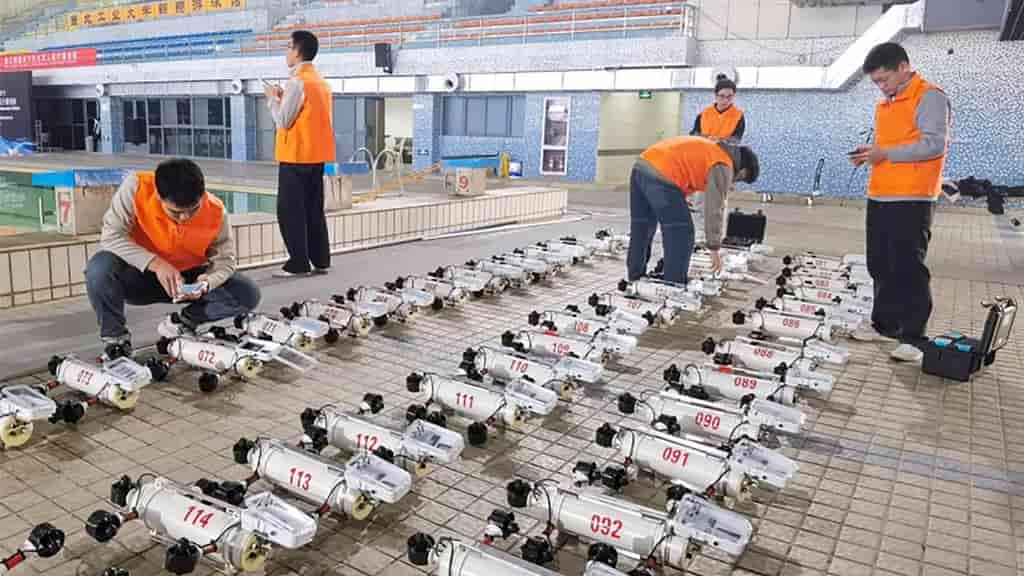
A Chinese team has established a new Guinness World Record for the simultaneous operation of autonomous underwater vehicles, deploying a swarm of 116 drones. The record was set by a collaboration between Northwestern Polytechnical University (NPU) and Xian Tianhe Maritime Technologies.
The TH-618 drones are designed to emulate the motion of manta rays, utilizing fin-based propulsion for stealth, energy efficiency, and agility. This biomimetic approach contrasts with traditional propeller-driven systems, allowing for quieter operation and maneuverability in complex underwater environments. Prototypes passed initial tests by 2023, with the drones positioned for broader deployment by 2025.
These drones have undergone deep-sea trials, demonstrating stable performance at depths exceeding 1,000 meters with a pressure-resistant hull and adaptable wing flaps. They are equipped with lithium-based battery systems, enabling over 24 hours of submerged operation on a single charge. Integrated high-resolution sonar and optical imaging modules facilitate ocean floor mapping and obstacle avoidance.
A key feature is their swarm intelligence, enabled by a custom communication protocol and AI algorithms. The drones can coordinate movements in formations, mirroring natural schools of fish, which offers advantages in collective mapping, problem-solving, and redundancy. They can adapt to environmental changes like obstacles or current shifts without centralized control, forming a decentralized network.
Potential applications span environmental monitoring, such as tracking marine life and mapping coral reefs, to national defense roles. The drones' stealth capabilities make them suitable for studying noise-sensitive species and for surveillance missions.