Key facts
- HUR said the Gerbera-2 has a wingspan of 3 meters and a fuselage length of 2.6 meters, with upgraded avionics and a larger fuel tank.
- HUR said it identified components made in the US, China, Taiwan, Switzerland, Ireland and the Netherlands in wreckage.
- The drone carries a rear-facing camera intended to detect approaching Ukrainian drone interceptors, per HUR.
- HUR said the enlarged fuel tank's range may let Russia use the drone beyond Ukrainian territory.
- Yurii Ihnat said Russia fired 4,000 jet-powered and 4,740 propeller-driven drones at Ukraine in October.
- Ihnat said some jet-powered Russian drones reach speeds of up to 600 kilometers per hour and fly at higher altitudes.
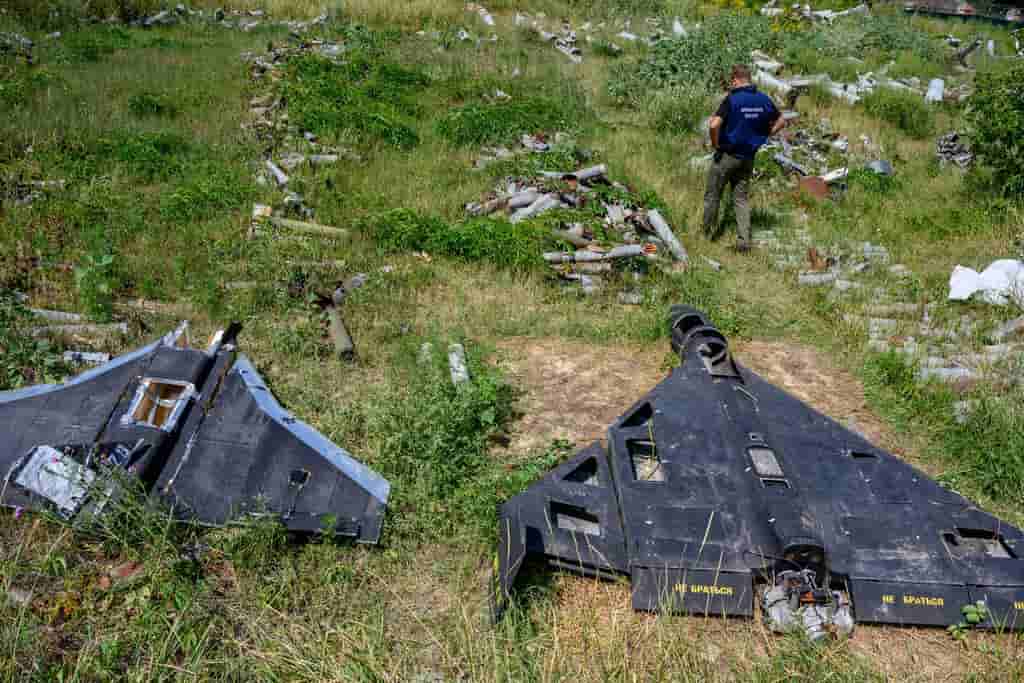
Ukraine's military intelligence agency, HUR, said Russia modified and enlarged its Gerbera decoy drone into a lightweight, long-range one-way attack drone it calls the Gerbera-2, according to a technical breakdown the agency published.
HUR said the Gerbera-2 has a range of 1,200 kilometers and carries a 25-kilogram warhead. The original Gerbera was built as an inexpensive decoy meant to overwhelm and confuse Ukrainian air defenses. The new version has a wingspan of 3 meters and a fuselage length of 2.6 meters, along with upgraded flight avionics and a larger fuel tank, HUR said.
HUR said its analysis of recovered wreckage identified components manufactured in the US, China, Taiwan, Switzerland, Ireland and the Netherlands. The drone also carries a rear-facing camera designed to detect approaching Ukrainian drone interceptors, which Ukraine uses to defend against Russian attack drones.
HUR said the greater range may indicate Russia intends to use the drone for attacks beyond Ukraine. "The increased operational range of the drone due to the large fuel tank indicates that its area of application may extend beyond the territory of Ukraine," HUR said in its analysis, adding that a Gerbera-2 carrying a warhead was discovered in mid-September on the Baltic coast of Poland.
Russia has sharply increased its use of drones in recent months, including jet-powered models capable of reaching speeds of up to 600 kilometers per hour and flying at higher altitudes, making them harder for Ukrainian air defenses to intercept. Yurii Ihnat, head of the Air Force's communications department, said on national television on November 2 that Russian forces launched 4,000 jet-powered drones and 4,740 propeller-driven drones at Ukraine in October.