Key facts
- China's plan targets an uncrewed Long March 10A and Mengzhou test in low-Earth orbit in early 2027.
- An uncrewed Long March 10 and Lanyue lander test including lunar descent and ascent is targeted for 2028.
- Two Long March 10 rockets would launch concurrently in 2029 to dock uncrewed Mengzhou and Lanyue in lunar orbit.
- The crewed landing mission would use a dual Long March 10 launch with crew aboard Mengzhou before 2030.
- NASA has set a target of landing humans on the Moon by 2028, about a year ahead of China's goal.
Chinese space officials confirmed at the Seventh Manned Spaceflight Conference in Beijing that the country plans to land astronauts on the Moon before 2030, laying out the most publicly detailed mission sequence yet, according to a report dated November 2, 2026. Wang Xiang, chief designer for the lunar exploration program, was among the officials who presented the plan.
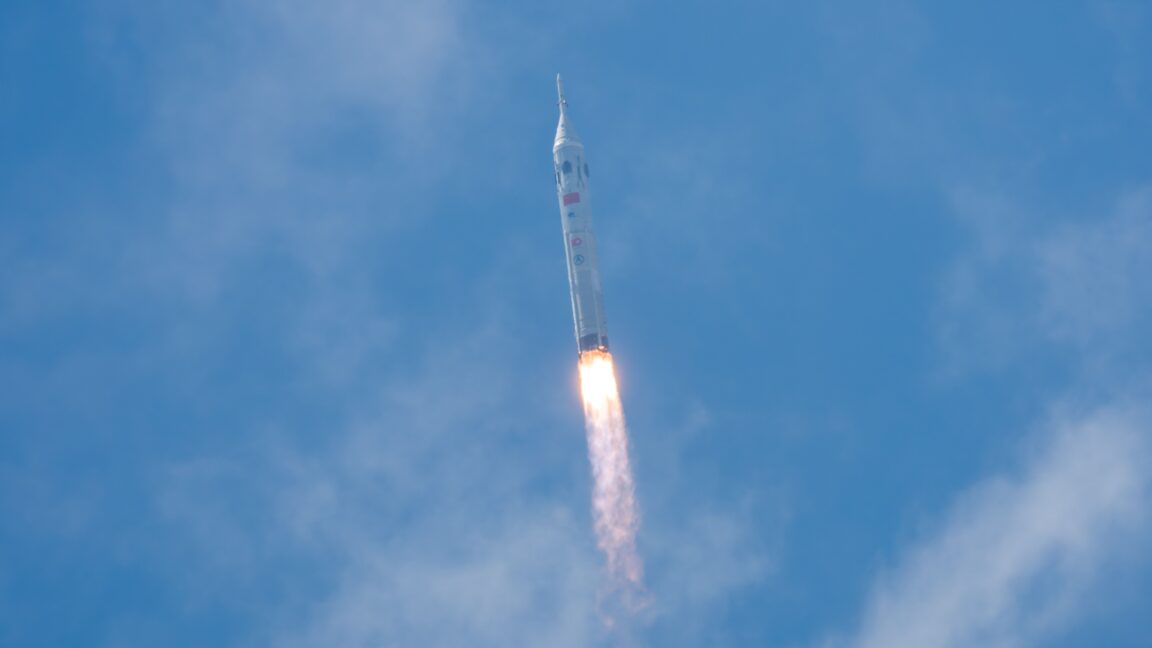
The sequence, shown in slides shared on social media, begins with an uncrewed test of the Long March 10A rocket, a single-stick variant with no boosters, and the Mengzhou spacecraft to low-Earth orbit, targeted for early 2027. An uncrewed test of the larger Long March 10, a core stage with two boosters, and the Lanyue lunar lander, including descent and ascent from the Moon's surface, is targeted for 2028.
In 2029 the plan calls for two Long March 10 rockets launching concurrently, one carrying an uncrewed Mengzhou and the other the Lanyue vehicle, to dock in lunar orbit. A dual launch with crew aboard Mengzhou would follow before 2030 for the crewed landing. The approach uses lunar-orbit rendezvous like the Apollo program, but because China lacks a rocket as powerful as the Saturn V, crew and lander launch separately.
The plan omits a mission comparable to Apollo 8 or Artemis II, in which a crew flies to the Moon and enters orbit or passes close by before returning. Mengzhou is expected to carry astronauts to Tiangong, China's low-Earth orbit space station.
NASA has set a target of landing humans on the Moon by 2028. The report says the US has a more established rocket and crew vehicle in the Space Launch System and Orion, but questions surround lunar lander development under multibillion dollar contracts with SpaceX and Blue Origin, and a US landing could slip to 2030 or later. NASA Administrator Jared Isaacman has moved to cancel the Lunar Gateway space station and planned Space Launch System upgrades, and announced plans to help Blue Origin's lander effort by finding a way to boost Orion into low lunar orbit.
In August 2025 the China Manned Space Agency tested a high-fidelity mockup of the 26-ton Lanyue lander using tethers to simulate lunar gravity. The Mengzhou spacecraft for the 2027 test has arrived at the Wenchang Space Launch Site in Hainan.