US shifts China approach from 'strength' to 'gung-ho' cooperation
1 source↑ Market-relevant
IN SHORT
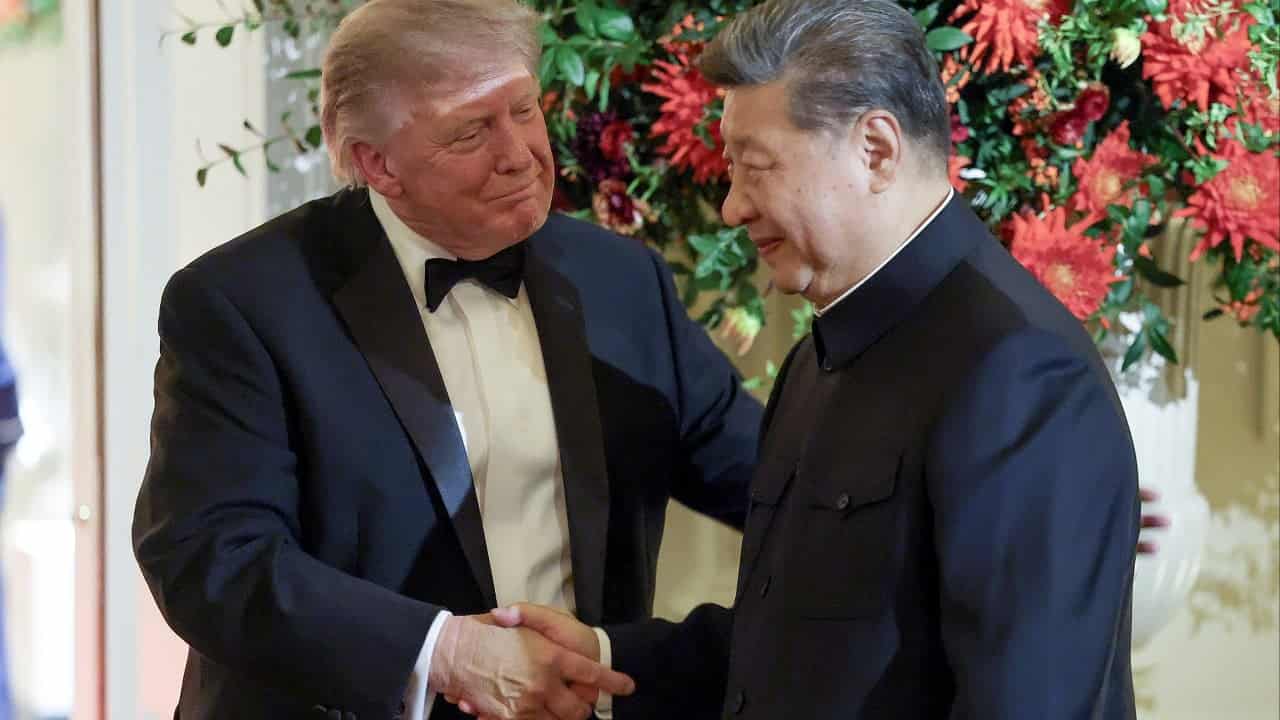
The US has formally adopted a new strategic framework for its relationship with China, moving away from a unilateral 'position of strength' to a 'constructive strategic stability relationship based on respect, fairness, and reciprocity.' The shift, formalized during a summit between US President Donald Trump and Chinese President Xi Jinping, aims to foster cooperation in trade, AI, and law enforcement.
Key Numbers
$30 billionreciprocal tariff reduction between US and China
Who's Involved
Donald Trump
US President who established new strategic framework with China
Xi Jinping
Chinese President who established new strategic framework with US
Evans Carlson
Officer who brought 'gung-ho' phrase to US Marine Corps
Yin Yuzhen
Chinese desertification fighter whose story inspired goodwill
↳ Why This Matters
The recalibration of US-China relations from competition to cooperation signals a potential de-escalation of geopolitical tensions, impacting global trade dynamics, technology development, and international stability. This shift could lead to more predictable economic policies and reduced risk for businesses operating in or exposed to both economies.
Key facts
US and China established a 'constructive strategic stability relationship' at a recent summit.
The new framework is based on 'respect, fairness, and reciprocity.'
The US has moved from a 'position of strength' to acknowledging China's power.
A $30 billion reciprocal tariff reduction was agreed upon in trade.
Communication channels for AI incidents were established.
Restored military crisis protocols aim to reduce risk.
The United States has shifted its approach to China from a unilateral 'position of strength' to a more cooperative 'constructive strategic stability relationship,' as formalized during a recent summit between US President Donald Trump and Chinese President Xi Jinping. This new framework, rooted in 'respect, fairness, and reciprocity,' acknowledges China's global standing and aims to foster pragmatic cooperation.
Key outcomes from the summit include a $30 billion reciprocal tariff reduction in trade, the establishment of formal Trade and Investment Councils, and the creation of communication channels for artificial intelligence incidents, with a dedicated governance dialogue planned for November. The restoration of military crisis protocols and joint efforts against illicit drug precursor networks were also highlighted as tangible results of this new partnership.
Beyond policy agreements, the summit emphasized human trust and cultural symbolism. President Trump invoked the phrase 'gung-ho,' meaning 'work together,' linking it to historical instances of shared sacrifice between the two nations. Symbolic gestures, such as Chinese roses at the White House and the arrival of giant pandas in Atlanta, underscored a reservoir of civilizational affinity beneath geopolitical competition.
The shift in US policy is also influenced by domestic realities, particularly among younger Americans. Public opinion polling indicates that Gen Z and Millennials, having grown up amidst global instability, recognize the necessity of co-existence and cooperation with China, viewing it as a formidable power rather than an existential enemy.
Frequently asked questions
The phrase 'gung-ho,' originating from Chinese Industrial Cooperatives in the 1930s, means 'work together.' It was adopted by the US Marine Corps as a battle cry for unity and common purpose.
This new framework signifies a move away from unilateral demands and towards mutual respect and reciprocity in managing the complex relationship between the US and China, aiming for pragmatic cooperation.
The previous approach was rooted in a belief that the US could dictate terms unilaterally. The new framework acknowledges China's power and standing, emphasizing fairness and reciprocity in dealings.
What Happens Next
01A dedicated governance dialogue for AI is scheduled for November.
✉Newsletter
Pick the topics you care about. Get only what matters, on your cadence.
How It Developed
US President Donald Trump and Chinese President Xi Jinping formally established a new strategic framework for their nations' relationship.
The new framework is described as a 'constructive strategic stability relationship based on respect, fairness, and reciprocity.'
The US officially moved away from a 'position of strength' approach to acknowledge China's global standing.
In trade, the nations agreed to a $30 billion reciprocal tariff reduction and formalized Trade and Investment Councils.
Communication channels for AI incidents were established, with a dedicated governance dialogue set for November.
Military crisis protocols were restored, and joint law enforcement crackdowns on illicit drug precursor networks were agreed upon.