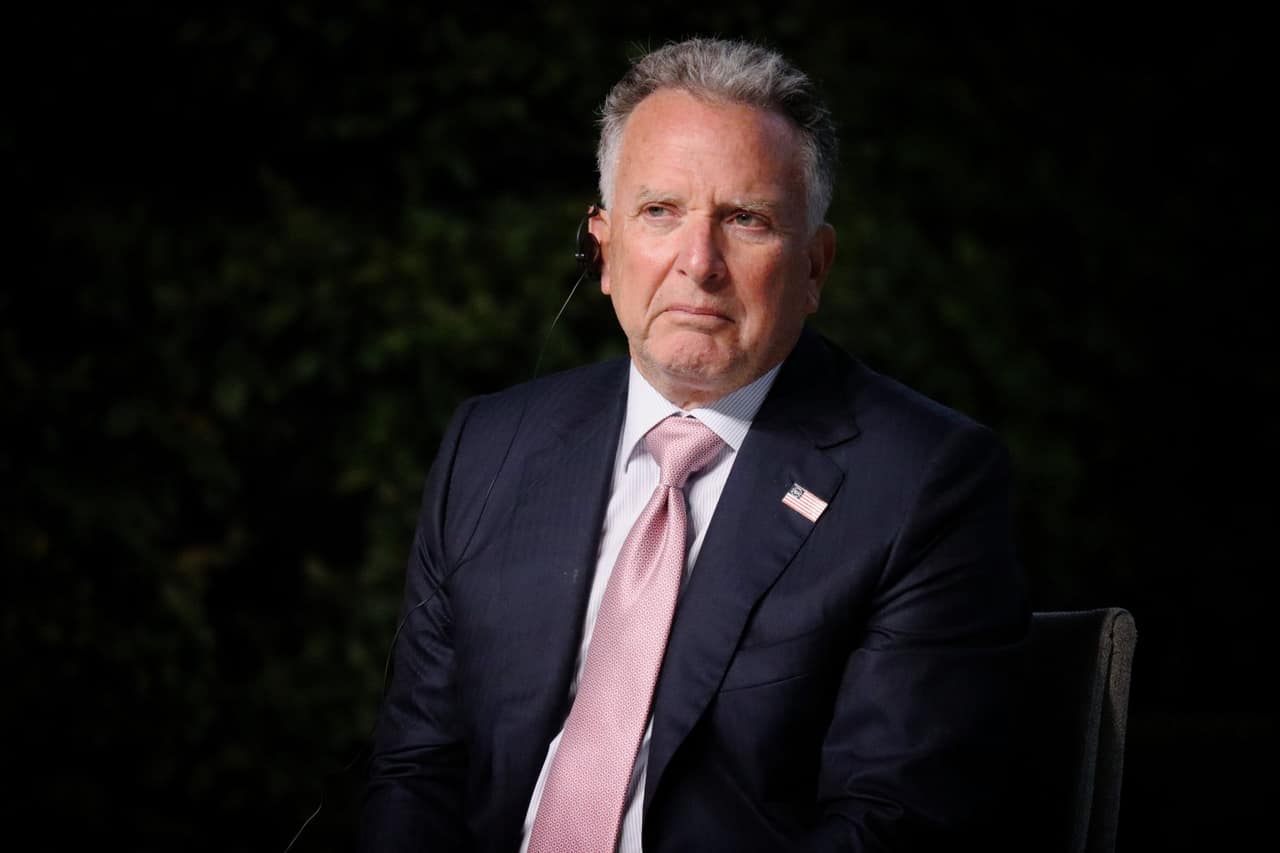
Kyiv and Moscow are growing increasingly frustrated with the U.S.-mediated peace process and with Washington's Envoy Steve Witkoff, people familiar with the matter told the Kyiv Independent. Witkoff and Trump's son-in-law, Jared Kushner, who has emerged as a key peace negotiator, traveled to Russia and Ukraine in early September in an attempt to restart stalled negotiations, but left with little to show for the effort.
Behind the scenes, several separate efforts are taking shape to remove Witkoff from the equation, and multiple tracks are also seeking to disrupt his close relationship with Russian envoy Kirill Dmitriev. Officials and people close to the process in both Kyiv and Moscow are questioning Witkoff's role. At the same time, Trump appears reluctant to dislodge Witkoff.
This frustration comes amid a broader problem with Washington's approach. Ukrainian officials say they are seeing few new ideas from the U.S. side and little willingness to increase pressure on Russia, while the Kremlin increasingly blames Witkoff for "diplomatic" failures and his inability to pressure Ukraine into giving up territories that Russia failed to capture militarily.
One Ukrainian official involved in the peace talks told the Kyiv Independent, "They keep telling us that 'you have to end this war.' As if we don't f***ing want to end it."
Ukrainian officials who participated in the peace talks and are familiar with the Kremlin's thinking say Russian officials increasingly believe Witkoff played a role in the failure of last year's summit in Alaska and sometimes passes information to Trump in ways that did not accurately reflect what Moscow intended. For now, that leaves the peace process in an unusual position: the negotiator who has become a source of frustration in both capitals remains the person Trump trusts to carry it forward.
Kyiv's skepticism toward Witkoff dates back almost to the beginning of his involvement in the negotiations. Ukrainian officials have long questioned his understanding of the war and his approach to diplomacy. One person who attended a round of trilateral negotiations told the Kyiv Independent that Witkoff sometimes left the negotiations without telling other participants where he was going. "He's more into restaurants and other stuff," the person said. "It really looks like the guy is not interested at all. He could leave the scene and go for a short walk."
For Ukrainian officials, such episodes have become part of a larger concern: that Witkoff does not appear to treat the negotiations with the seriousness they require. His relationship with Russian President Vladimir Putin has only deepened those concerns. Witkoff has met Putin at least seven times and has repeatedly spoken warmly about those encounters. During their latest meeting on Sept. 5, he told Putin, "After I retire, I'll look back on my meetings with (you) in the Kremlin as some of the best and most unforgettable moments of my life."
Ukrainian officials view such praise as an overly accommodating approach toward the Russian president, a wanted war criminal. They argue that this approach is unlikely to persuade Putin to make meaningful concessions. But the problem, in their view, goes beyond Witkoff's personal style. His understanding of the war and its history has also become a recurring source of frustration.
That became particularly visible in the spring of 2025, shortly after Witkoff took responsibility for the peace track. In April, Witkoff described his first discussions with Putin as "compelling" and said they focused on a potential peace agreement involving what he called "five territories." "This peace deal is about these so-called five territories," Witkoff said. "I think we might be on the verge of something that would be very important for the world at large." The Kyiv Independent revealed that Witkoff's public description echoed details discussed during an earlier meeting with Putin. During their April 11 meeting, Putin was sketching on a sheet of paper when Witkoff asked what he was drawing. Putin showed him the page, which contained the notation "3+2" — a reference to the territorial concessions the two men had discussed. Witkoff took the paper with him back to Washington. The five territories in question were the Russian-occupied parts of Donetsk, Luhansk, Zaporizhzhia, Kherson, and Crimea. Russia later illegally incorporated all five into its constitution following sham referendums.
The episode became emblematic of what Ukrainian officials saw as a deeper problem: Witkoff was discussing some of the most consequential questions of the war without appearing to fully understand the territorial issues at stake. For Kyiv, such unseriousness and the lack of understanding of the sensitivity of the issue are the main problems.
The Kremlin, meanwhile, was developing its own frustrations with the U.S. envoy. People briefed on Ukrainian intelligence said Russian officials had come to believe that Witkoff was partly responsible for the failure to achieve a breakthrough at last year's summit between Trump and Putin in Alaska. One person briefed on Ukrainian intelligence and familiar with the negotiations described Witkoff as someone Putin initially viewed as a useful channel into the Trump administration. The Russian president, the person said, believed Witkoff could be persuaded to accept or relay Moscow's proposals to Trump. That relationship became more complicated in the weeks leading up to Alaska. Just a week before the summit, Witkoff returned from a meeting with Putin without a stenographer. He relied on the Kremlin's translator, not a U.S. embassy interpreter, thereby breaking traditional diplomatic protocol. After that meeting, Witkoff told Trump that Putin was prepared to discuss an arrangement under which Ukraine would withdraw from parts of Donetsk and Luhansk oblasts, while Russia would pull back from territory it controlled in parts of Kherson and Zaporizhzhia oblasts, one U.S. official said. But the Russian president was not prepared to offer those concessions, according to the source. Witkoff misunderstood Putin's "3+2" position. When U.S. officials briefed Ukrainian and European counterparts on what Witkoff had conveyed, the reaction was disbelief. In Kyiv, there was an immediate understanding of miscommunication between the two, one person said. The discrepancy became impossible to ignore when Trump announced plans for the Alaska summit and it emerged that Putin was not prepared to make the territorial concessions Witkoff had described. More importantly, one participant in the peace talks alleged that Witkoff failed to convey to Trump that Putin wanted the understandings reached in Alaska to be formally documented. That left the summit without a concrete written framework that could serve as the basis for subsequent negotiations.