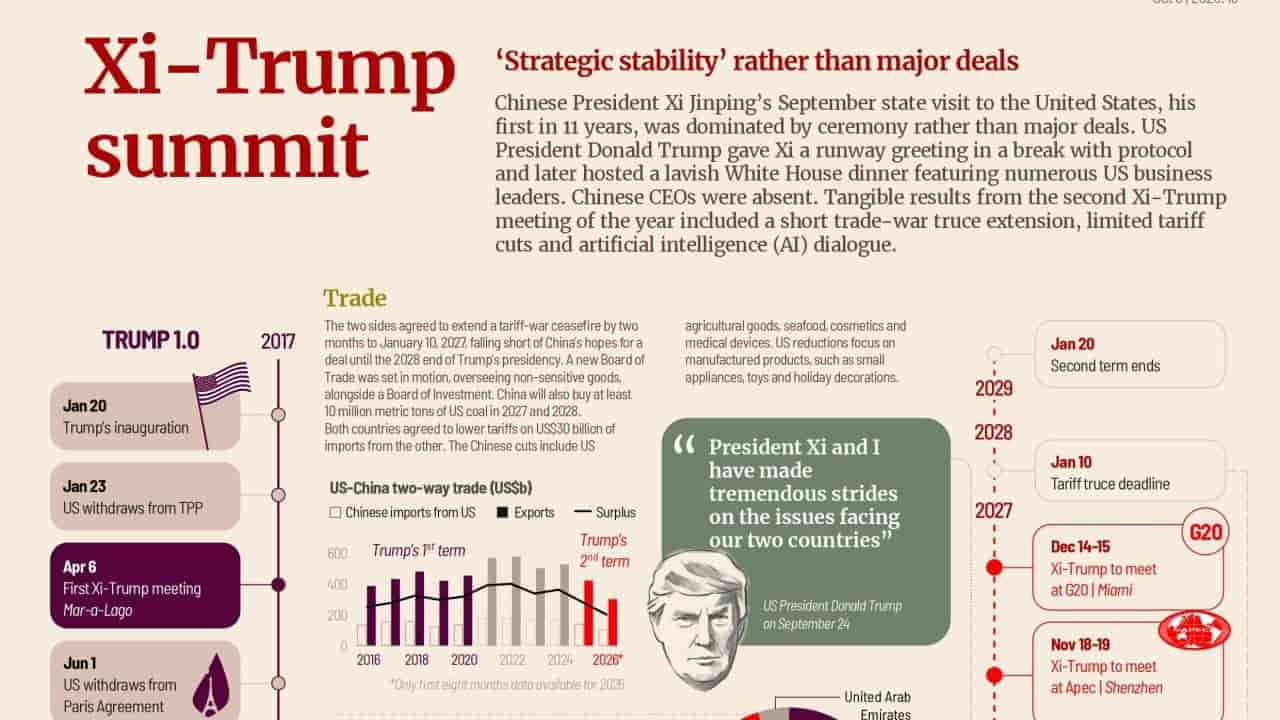
Presidents Donald Trump and Xi Jinping met at the White House for Xi's first state visit to the United States in over a decade, engaging in talks that covered trade, Taiwan, Iran, AI, and fentanyl.
Both sides released readouts of the summit, highlighting different priorities. China's list began with the establishment of a constructive and strategically stable China-U.S. relationship, while the U.S. side prioritized counternarcotics cooperation, the loan of giant pandas, and trade and investment.
Key outcomes included a mutual agreement on a "constructive and strategically stable China-U.S. relationship based on respect, fairness and reciprocity." Reciprocal tariff reductions covering $30 billion worth of trade were also agreed upon, along with the establishment of an AI dialogue and joint counternarcotics law enforcement efforts. China reiterated its position on not developing nuclear weapons, while the U.S. side notably omitted any mention of North Korean denuclearization.
Regarding Taiwan, the Chinese readout stated Xi's hope that the U.S. would "oppose Taiwan independence," a point not mentioned in the White House fact sheet. U.S. Ambassador to China David Perdue stated that U.S. policy on Taiwan had not changed, emphasizing peace across the Taiwan Strait and opposition to coercion. Secretary of State Marco Rubio indicated that decisions on arms sales to Taiwan are under review, dependent on U.S. defense-industrial capacity and global requirements.
Analysts noted that the summit was heavy on symbolism but light on substance, with minimal progress beyond general agreements. Some expressed concern that the lavish welcome for Xi, in return for limited concessions, could undermine U.S. credibility and deterrence.