Key facts
- Researchers entangled a light beam with a suspended glass bead.
- The experiment used an optical cavity to confine laser light and a cooled glass bead.
- The entanglement allows information to be stored as a memory in the mechanical system.
- This is the first measurement of its kind, with potential applications in quantum communications.
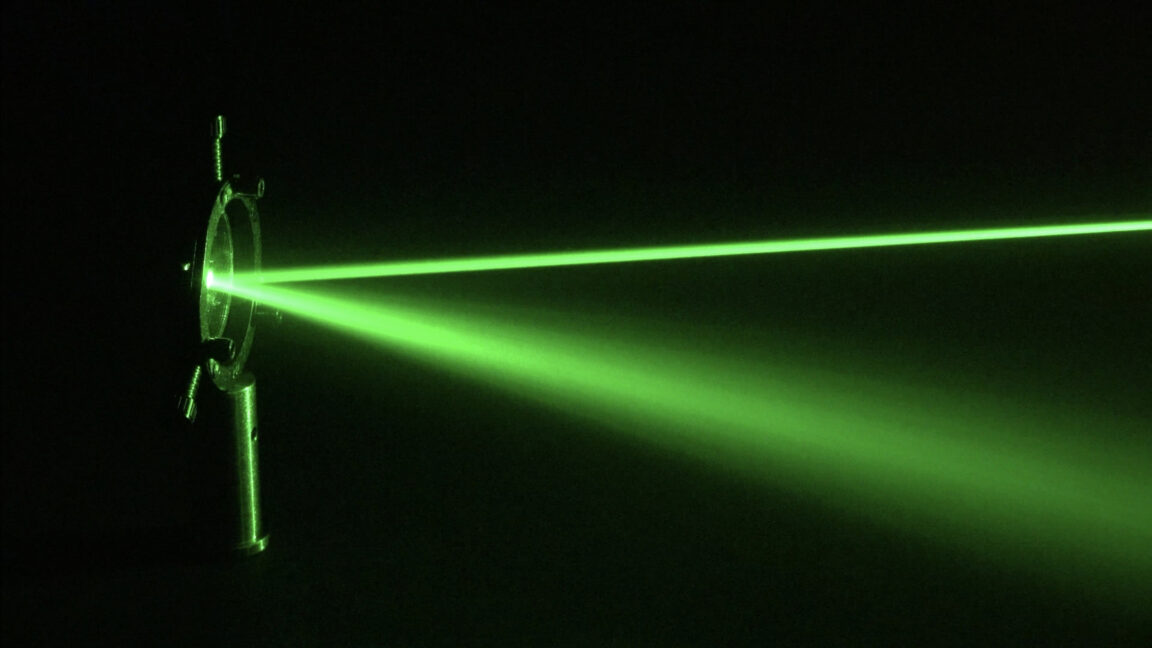
Scientists have achieved a significant breakthrough by entangling a light beam with a suspended glass bead, a feat that pushes the boundaries of quantum mechanics. The experiment, detailed in Science, involved using laser light to suspend and cool a small glass bead within an optical cavity. This setup, where the distance between mirrors defines the light field's properties, created a standing wave pattern. By carefully manipulating the laser frequency—first cooling the bead by reducing the frequency (redder color) and then heating it by increasing it (bluer color)—the researchers induced entanglement between the light fields and the bead's motion. Tiny fluctuations in phase and amplitude of light leaking from the cavity were then measured to confirm this entanglement. This achievement is notable because the size of the bead typically causes such correlations to be washed out. The researchers see potential applications in quantum communications, specifically for storing light, which is notoriously difficult. This mechanical system could serve as a local memory for quantum information, offering a customizable solution for future quantum technologies.