Key facts
- A replica of the 1976 Cray-1 supercomputer has been built using 30 Mac Minis.
- The Mac Minis are networked to achieve 1.3 teraflops of performance.
- The original Cray-1 had a peak theoretical performance of approximately 160 megaflops.
- The replica uses macOS Mojave for its built-in MPI support.
- The project was developed over 18 months as a tribute to the Cray-1 and Apple.
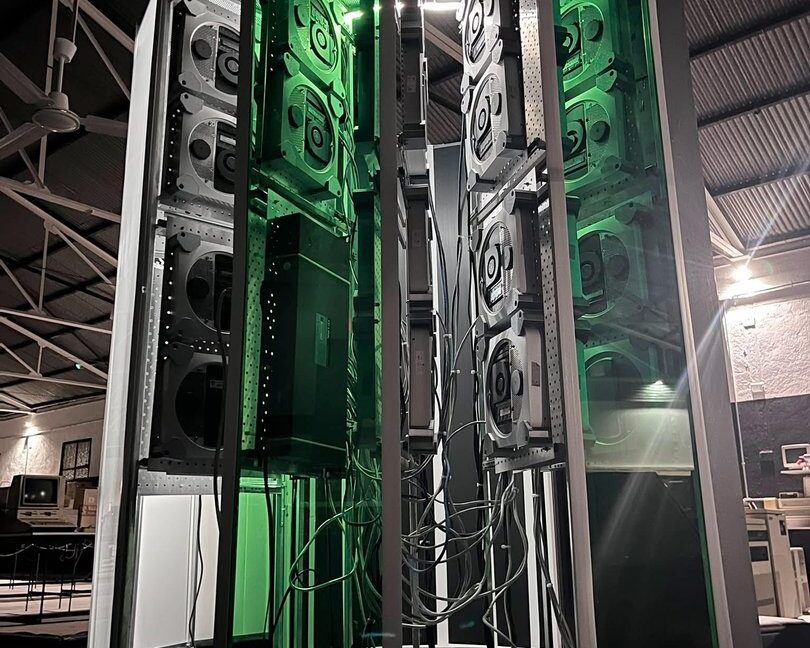
The Museo de Historia de la Computación in Spain has unveiled a full-scale replica of the 1976 Cray-1 supercomputer, built using 30 networked Mac Minis from 2012. The project, which took 18 months to develop, serves as a tribute to both the original supercomputer and Apple's founding.
While seemingly an unconventional choice, the developers networked the Mac Minis to achieve a combined performance of 1.3 teraflops in recent tests, utilizing 64 active processing cores. Previously, they reportedly reached 1.5 teraflops using all 70 available cores before one node went offline. The performance benchmarks were established using a custom Python script for matrix multiplication. The cluster comprises five quad-core i7 PCs and 25 dual-core i5 PCs, with most units dating to 2012 and two from 2014.
The replica offers museum visitors insight into the evolution of computer architecture. The original Cray-1 employed vector processing, while the replica utilizes parallel cluster processing. The original Cray-1's peak theoretical performance was around 160 megaflops, significantly less than the capabilities of the modern consumer hardware used in the replica.
The team opted for macOS Mojave (10.14) over standard Linux distributions due to its built-in support for Message Passing Interface (MPI), which enables task distribution among the cluster nodes. Guests can observe the system running matrix algorithms in real time, demonstrating performance scaling from a single core to the full parallel setup.
For cooling, the museum team implemented passive convection cooling using a steel rack chassis and aluminum tray mounts for each Mac Mini, resulting in a nearly inaudible system compared to the loud fans typically found in server rooms.