Key facts
- A Chinese national was rescued alive from a hydropower tunnel in Nepal on Saturday, 10 days after floods.
- Two Nepalese workers were previously rescued from the Trishuli 3A hydropower plant on Friday.
- Approximately 900 workers are missing from 12 hydropower projects, with about 500 believed trapped in tunnels.
- The floods, likely caused by a glacier collapse, have killed at least 1,300 people and left over 5,000 missing.
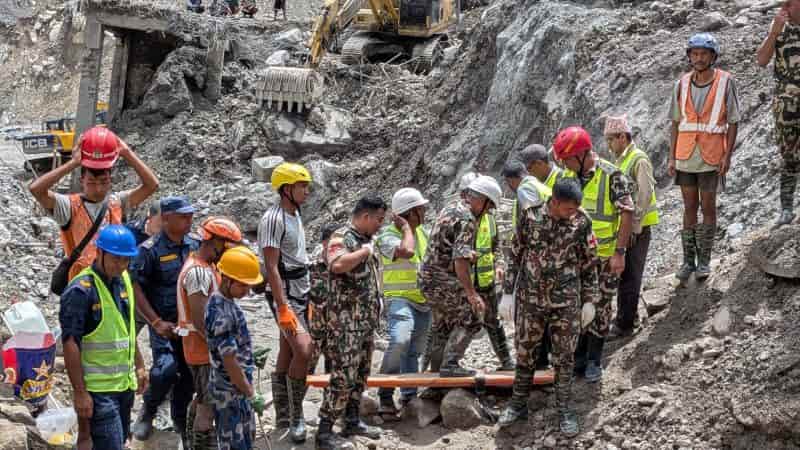
- Rescue efforts are ongoing at multiple hydropower sites, involving clearing debris and pumping water from tunnels.
Rescuers in Nepal have successfully pulled a Chinese national alive from a hydropower tunnel, 10 days after catastrophic floods struck the region. The rescue on Saturday brings the total number of survivors recovered from the Trishuli hydropower project to three, offering a glimmer of hope amidst a devastating disaster.
Two Nepalese workers, Sanjay Sah, 30, and Kabir Maharjan, 45, were rescued on Friday from a tunnel at the Trishuli 3A hydropower plant. Sah recounted chanting Hindu mantras to sustain himself during the nine-day ordeal, while Maharjan is reportedly in critical condition. Authorities also recovered a body from the same tunnel.
The Chinese national was extracted from a 225-meter tunnel and is currently undergoing medical evaluation. Images depicted the survivor being airlifted by helicopter, with an army medic attending to him during the flight.
These rescues come as hundreds of workers remain missing. Authorities estimate that around 900 workers are unaccounted for across 12 hydropower projects, with approximately 500 believed to be trapped in various tunnels. The floods, which occurred on August 26 and are suspected to be caused by a glacier collapse near the Nepal-Tibet border, have resulted in at least 1,300 confirmed deaths and left over 5,000 people missing.
Rescue operations are continuing across multiple sites, including the Trishuli 3B and Upper Trishuli-1 tunnels, where teams are working to clear debris and establish connections. The Nepali Army has deployed over 9,300 personnel to assist in rescue efforts, provide medical aid, and reopen blocked roads. An engineering team is also installing a bridge over the Tadi River.
