Key facts
- Kyiv is experiencing an increase in Russian drone and missile attacks throughout the day.
- The intensified Russian campaign, starting in late August, has altered daily life in the capital.
- Recent attacks have targeted residential buildings, infrastructure, and educational facilities.
- Sociologists note that Kyiv residents are showing signs of stress and anxiety similar to those closer to the front lines.
- A majority of Kyiv residents surveyed support continuing armed resistance despite the attacks.
Kyiv is increasingly experiencing Russian drone and missile attacks throughout the day, blurring the lines between wartime nights and normal days. The intensified campaign, which began in late August, has changed the rhythm of life in the Ukrainian capital, with residents reporting heightened anxiety and a sense of living in a frontline region.
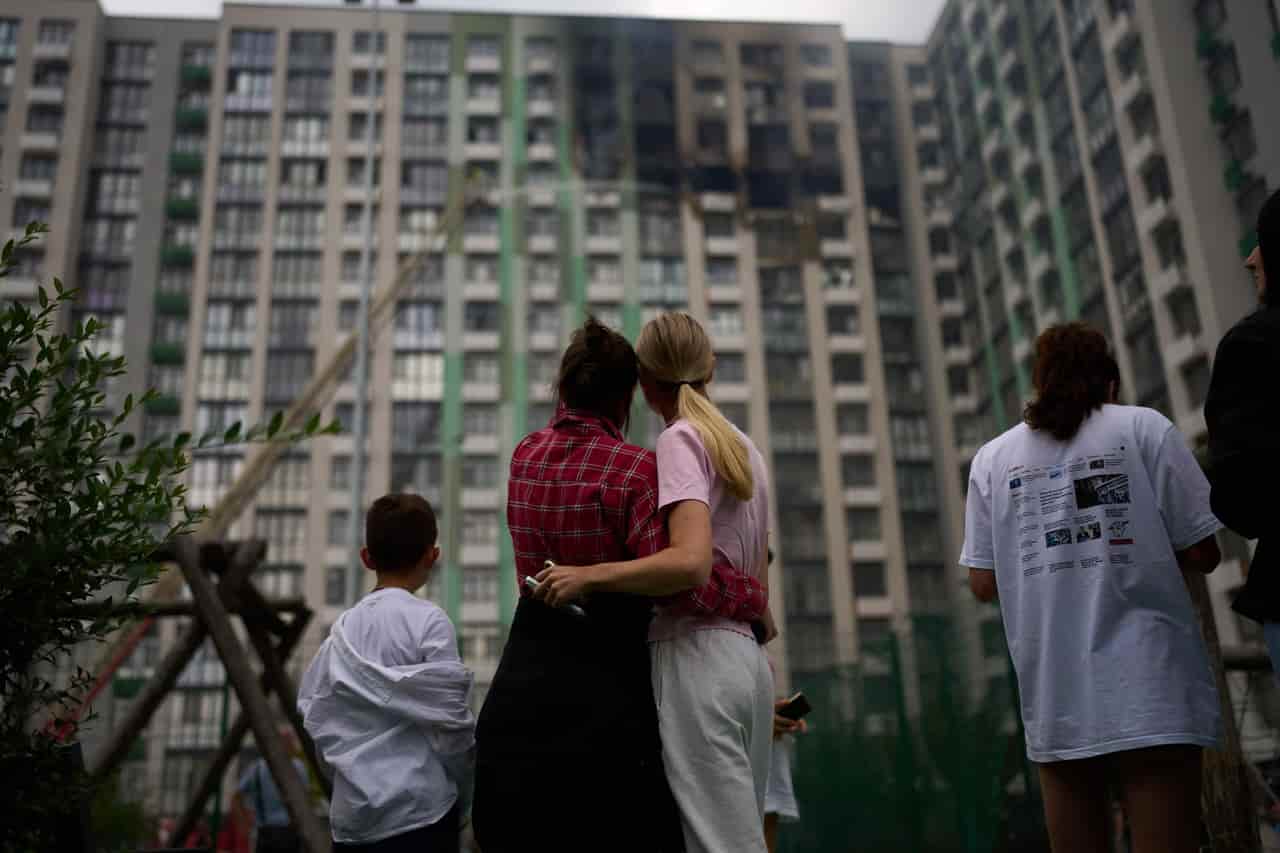
Firefighters worked after a Russian drone attack struck a residential building in Kyiv on September 1, 2026. For much of Russia's full-scale war, massive attacks on Kyiv came mainly at night, allowing residents to organize their lives around them. However, this fragile division is disappearing as Russia increasingly launches jet-powered attack drones toward the capital around the clock, bringing air raid alerts, air defense fire, and explosions into the middle of workdays, commutes, and afternoons.
The last days of September and the first of October were particularly intense. On September 25, 2026, a Russian drone tore into a high-rise apartment building in the central Pecherskyi district, killing a 14-year-old boy. The next morning, residents had already heard the air raid siren five times by 10 a.m. On September 27, another attack stretched into a nine-hour alert. On September 28, Russian drones struck central Kyiv in broad daylight, killing two people and injuring 26. A building of Ukraine's National Academy of Sciences caught fire. Videos showed people trying to escape through windows as smoke poured from inside. The following night, Russian missiles and drones hit an educational facility, apartment buildings, a railway depot, data centers, and business centers. By September 30, Russia had struck again, targeting Kyiv's energy infrastructure, leading to emergency power shutdowns. On October 1, a drone hit a school, and two others struck the Southern Bridge as cars and a metro train were crossing. The next day, bridge restrictions caused major traffic jams across the city.
Between September 25 and October 2, 2026, at least 16 people were killed and more than 100 others injured in Kyiv and the surrounding region. The highest number of injuries came on September 25, when at least 59 people were wounded as drones caught residents in the middle of the working day. By the end of this intense stretch, the city had disappeared beneath a dense gray haze of smoke from the attacks, prompting authorities to urge residents to keep their windows closed. Parts of the city were without electricity, and after more than a week of continuous strikes, the city looked exhausted.
Sociologists are observing a shift in Kyiv residents' experiences, with indicators such as worsening health, loss of income, and damage or destruction of property increasingly resembling those in Ukraine's eastern regions closer to the front line. Oleksii Antypovych, director of Rating Group, stated that Kyiv can now, to some extent, be called a frontline region. He described the prevailing mood as anxiety and uncertainty about security and the city's protection.
A survey conducted by the Kyiv International Institute of Sociology (KIIS) from August 21 to September 10, 2026, found that 83% of Kyiv residents believed Ukraine should continue armed resistance even if Russia tried to deprive people of electricity, heating, and water during the winter. Anton Hrushetskyi, KIIS executive director, noted that Kyiv had the highest share of people supporting continuing armed resistance under any circumstances compared to other surveyed regions. A separate KIIS survey from late July and early August 2026 found that the share of Kyiv residents ready to endure the war for as long as necessary had risen from 61% to 69% since April.
Daria Lisich, a 28-year-old poet, found that intensified attacks near her home prompted her to leave Kyiv for Lviv for three weeks. Semen Krishtal, a 27-year-old creative marketer, has intensified thoughts of leaving Kyiv due to the attacks, particularly after a drone struck the National Academy of Sciences on September 28, 2026, while he was on a trolleybus. He described coping by listening to music at full volume to manage anxiety.