Key facts
- President Zelensky believes Russia shared jet-drone technology with North Korea.
- Germany announced a new aid package for Ukraine worth over €1.3 billion ($1.46 billion).
- The package includes funding for interceptor drones and energy assistance.
- Ukrainian drones struck two Russian fighter aircraft and an ammunition depot in Russia's Republic of Adygea.
- Russia struck Kyiv's Northern Bridge with a drone on Oct. 4, injuring two people.
- Russia has used over 1,900 attack drones, 1,700 aerial bombs, and 25 missiles against Ukraine in the week prior to Oct. 4.
Ukrainian President Volodymyr Zelensky stated that Russia may have shared advanced jet-drone technology with North Korea, which has been supplying Russia with missiles and artillery shells. This assertion comes as Germany announced a significant new aid package for Ukraine.
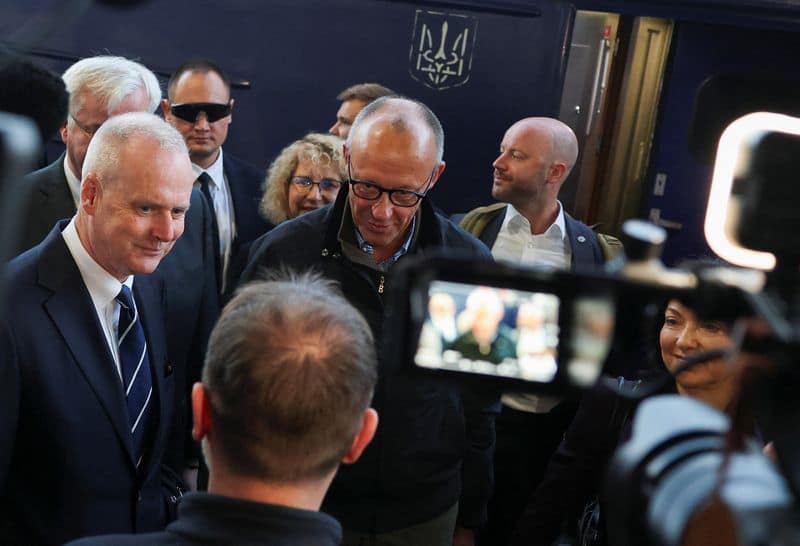
Germany's support package, valued at over €1.3 billion ($1.46 billion), includes funding for interceptor drones designed to counter Russia's jet-powered attack drones and assistance for Ukraine's energy sector. The package was announced by Zelensky and German Chancellor Friedrich Merz during a joint press conference in Kyiv. Zelensky highlighted that the total value of agreements reached exceeded €8.5 billion ($9.57 billion), with a special focus on joint counter-drone efforts.
The military aid component of the package amounts to €1 billion ($1.13 billion) and will finance the production of interceptor drones. Additionally, Ukraine will receive thousands of missiles for its German-made IRIS-T air defense systems, along with additional IRIS-T fire units. The energy assistance, totaling around €350 million ($394 million), will support generators and repairs to infrastructure damaged by Russian attacks, aiming to mitigate the impact of strikes ahead of winter.
As part of the drone initiative, German drone manufacturer Quantum Systems will receive financing to produce tens of thousands of interceptors in Ukraine. Quantum Systems also signed a memorandum of understanding with Ukrainian defense company Fire Point to jointly develop new technologies for unmanned systems. Other German and Ukrainian companies also signed MOUs, including Culver Aerospace with Helsing for long-range strike systems and Roboneers with ARX Robotics for ground drones.
In parallel, Ukrainian drones reportedly struck two Russian fighter aircraft, a Su-35 and a Su-34, along with an ammunition depot at the Khanskaya military airfield in Russia's Republic of Adygea. The Security Service of Ukraine (SBU) claimed responsibility, stating the targeted aircraft are used to deploy guided aerial bombs along the front line and against Ukrainian cities. The SBU estimated the export value of a Su-35 at $100 million and a Su-34 at $50 million.
Meanwhile, Russia continued its attacks on Kyiv, striking the Northern Bridge across the Dnipro River with a drone on the morning of Oct. 4, injuring two people. Mayor Vitali Klitschko reported the incident, noting it was the fourth consecutive day Russian forces targeted bridges in the capital. Zelensky stated that Russia had used over 1,900 attack drones, 1,700 aerial bombs, and 25 missiles against Ukraine in the preceding week. The strike on the Northern Bridge also damaged a heating main, temporarily disrupting hot water supply to parts of Kyiv's Desnianskyi district.