Key facts
- Oil companies are asking the Supreme Court to rule that federal law preempts state climate deception lawsuits.
- The case before the court was brought by Boulder, Colorado, against ExxonMobil and Suncor Energy.
- Boulder seeks damages for climate-related extreme weather, arguing the companies deceived the public.
- Oil companies argue that state laws cannot regulate global conduct and that federal law blocks such claims.
- Some justices appeared inclined to agree that federal law preempts at least some of Boulder's claims.
- Justice Samuel Alito recused himself, potentially leading to a tie vote.
The US Supreme Court heard arguments on Monday from oil companies seeking to dismiss more than two dozen lawsuits that accuse the industry of deceiving the public about climate change. The companies argue that federal law should block these state-level claims, which seek billions of dollars in damages to cover the costs of climate-related extreme weather.
The central case being argued is from 2018, brought by the city and county of Boulder against ExxonMobil and Suncor Energy. While these cases have survived multiple appeals, the oil companies are asking the Supreme Court to rule that federal law preempts state and local governments from pursuing such claims. Kannon Shanmugam, representing Exxon and Suncor, argued that Boulder's lawsuit represents an "unprecedented effort to use state law to regulate global conduct" and could allow numerous municipalities to dictate national energy policy.
However, Boulder and other plaintiffs contend their claims focus on deception rather than limiting oil company activities. Kevin Russell, arguing for Boulder, stated, "This case is not about emissions. It’s about deception." The arguments before the court centered on technical legal questions, including whether the court has jurisdiction at this stage and whether federal law, such as the Clean Air Act or the Constitution, preempts state claims about climate change and emissions.
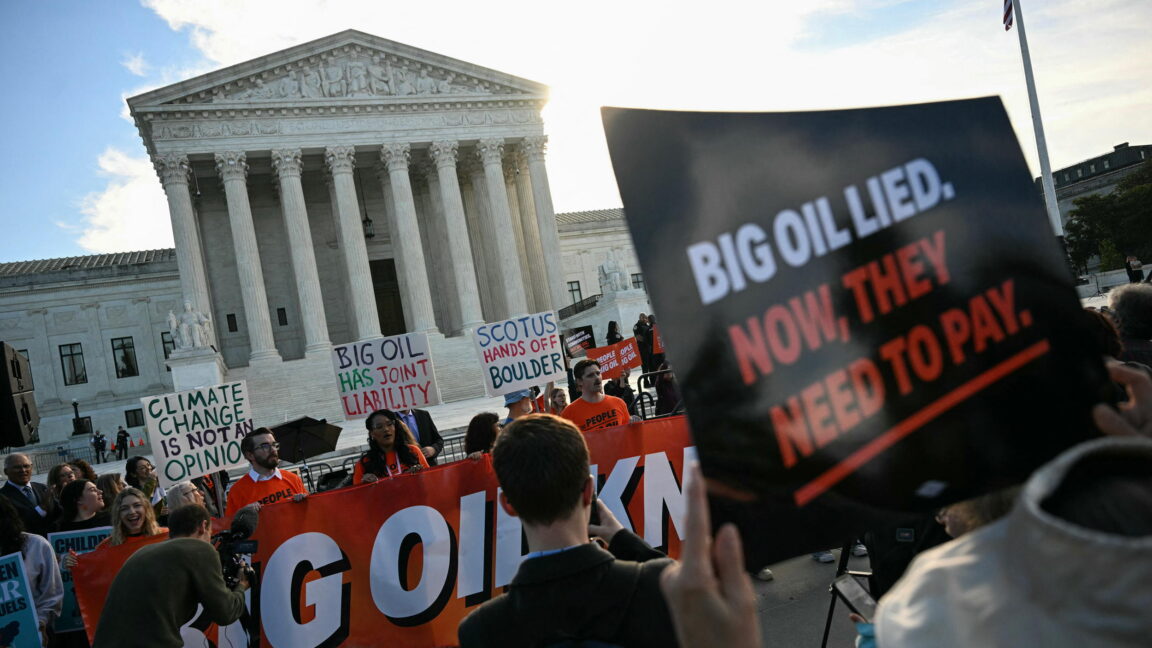
Some justices expressed skepticism about intervening early in the cases, while others seemed inclined to agree that federal law might preempt some of Boulder's claims. Justice Samuel Alito recused himself from the hearing due to his ownership of stock in oil companies involved in similar lawsuits, leaving open the possibility of a tie vote. Supporters of the lawsuits rallied outside the court, emphasizing the daily realities of climate change impacts faced by communities like Boulder.