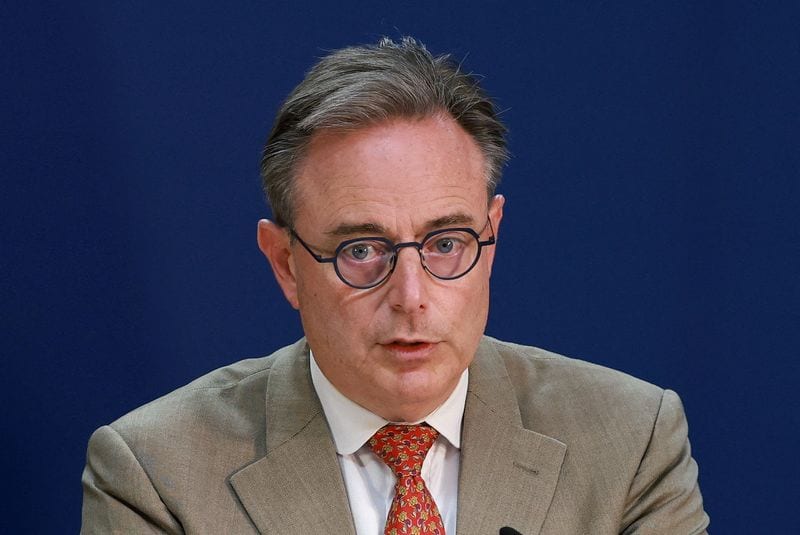
Belgian Prime Minister Bart De Wever will meet King Philippe on Friday, November 6, 2026, to determine whether he resigns or stays in office after budget talks collapsed. De Wever offered his resignation to the king on Monday, and the palace said the monarch would consult coalition leaders from Tuesday to Thursday before meeting the prime minister again.

Belgium must find €10 billion to stabilize its finances, and the European Commission forecast in May a debt-to-GDP ratio of 110.5% this year, the fourth highest in the euro zone. Belgian 10-year benchmark bonds were trading at a 4.25% yield late on Thursday, up from 3.48% four months earlier.
Belgian Prime Minister Bart De Wever will meet King Philippe on Friday morning to determine whether he will resign or continue in office, after the collapse of budget negotiations sparked a government crisis.
De Wever offered his resignation in a 90-minute meeting with the king on Monday morning. The palace said the monarch would consider the offer but would also consult the leaders of the coalition partners from Tuesday to Thursday. The king is due to meet De Wever again on Friday morning.
In a parliamentary session on Thursday, De Wever indicated he was more inclined to stay on than go, saying he still hoped to secure a budget that could bring financial stability for the coming years. "We need to rid ourselves of past mismanagement and bring in an era of responsibility. I only want to be prime minister of a government that prioritises that task," he said, adding that he did not rule out a new round of negotiations with the current coalition. "We will see how things evolve over the coming days and weeks," he said.
There is precedent from a year ago, when De Wever reported back to the king about problems over the federal budget negotiations and subsequently gave his coalition partners a Christmas deadline to reach an agreement.
Belgium's challenge is to find €10 billion ($11.23 billion) to stabilize its finances, but some parties say that should be achieved with budget cuts, while others say tax increases are required.
The crisis coincides with heightened stress on financial markets, where interest rates have risen sharply on government bonds of Belgium, France and other European countries seen to have weak government finances. The European Commission forecast in May that Belgium's debt-to-gross domestic product ratio would be 110.5% this year, behind only Greece, Italy and France among euro zone countries, with a projected general government deficit of 5.2% of GDP.
Belgium's 10-year benchmark bonds were trading at a yield of 4.25% late on Thursday, against 4.79% for France and 3.24% for Germany. Four months ago, Belgian 10-year yields were at 3.48%.
Pick the topics you care about. Get only what matters, on your cadence.