Key facts
- Webb's NIRSpec recorded a full spectrum from 0.6 to 5.2 micrometers for every point in the image.
- The team found slightly more than one carbon dioxide molecule for every 10 water molecules, about 11 percent of the ice.
- That share falls within the 2.5 to 30 percent range measured in Solar System comets.
- The team estimates less than 7 percent of the water ice in the system is crystalline.
- Amorphous ice stays in that form only below about 100 Kelvin, or minus 173 degrees Celsius, the team said.
- The team said frequent collisions among planetesimals spread fresh icy dust evenly across the disk.
Astronomers using the James Webb Space Telescope reported on November 14, 2026, that they had detected water and carbon dioxide ice in the debris disk around Beta Pictoris, a star about 20 million years old and roughly 64 light-years from Earth. The study, published in Science, was led by Sarah Betti, an astronomer at the Space Telescope Science Institute in Baltimore.
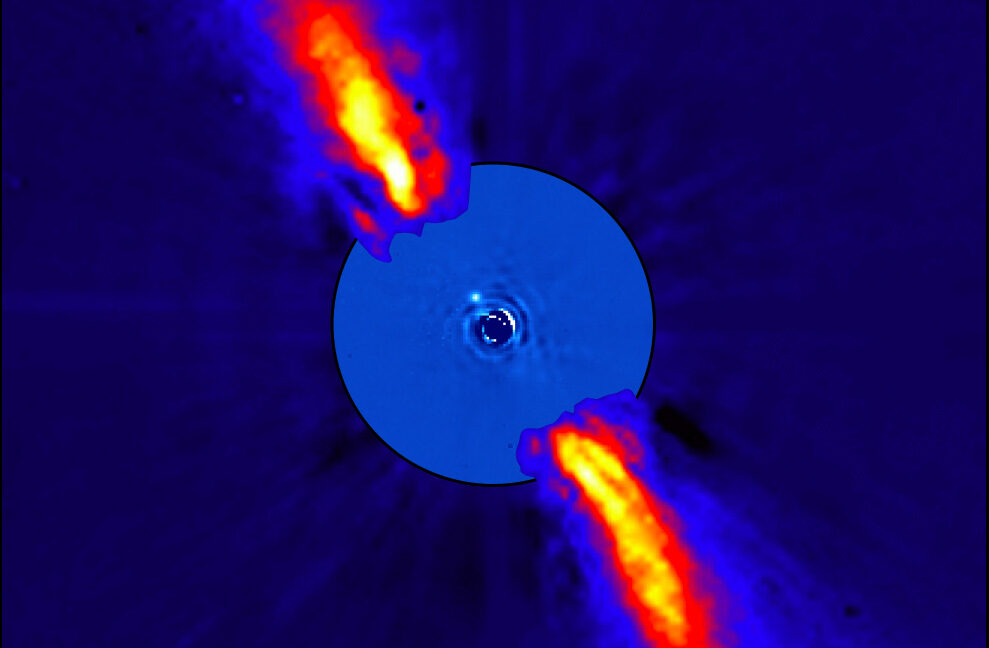
Beta Pictoris is surrounded by a disk of dust and rubble where planets are still forming, and astronomers have already found three. The disk was among the first ever imaged, in 1984, and is seen almost exactly edge-on. Its dust is constantly replenished by collisions among comets and planetesimals, the small bodies that are the building blocks of planets.
Earlier searches for ice in the system had failed. Attempts to detect water vapor found nothing, and a search for the dip that water ice leaves in starlight at a wavelength of 3 micrometers also failed. Theoretical models held that ultraviolet radiation from the star can destroy small grains of pure ice faster than collisions can produce them, while grains of dirty ice mixed with other molecules should survive longer.
Betti and her colleagues observed Beta Pictoris on December 7, 2023, using Webb's Near Infrared Spectrograph in a mode that records a full spectrum, from 0.6 to 5.2 micrometers, for every point in the image. After subtracting the star's glare, the team measured how much starlight the disk's dust reflects at each wavelength. Water ice absorbs light strongly near 3 micrometers, while carbon dioxide ice absorbs at 4.27 micrometers or 4.39 micrometers when it contains the heavier carbon-13 isotope.
The team mapped the water ice features across the disk and found them strikingly uniform. Spectra extracted from two spots on opposite sides of the star, each roughly 100 astronomical units out, showed water and carbon dioxide ices, the latter in both its common form and the rarer carbon-13 version.
The carbon dioxide features were shifted slightly toward shorter wavelengths and were much broader than those of pure carbon dioxide ice measured in the lab. The team said in the paper that this is how carbon dioxide behaves when its molecules are trapped inside water ice, meaning the two ices are thoroughly mixed rather than sitting side by side as separate grains. The team calculated slightly more than one carbon dioxide molecule for every 10 water molecules, about 11 percent of the ice, within the 2.5 to 30 percent range measured in Solar System comets and the 7 to 20 percent seen in disks around other newborn stars.
The water ice was almost entirely amorphous, a disordered, glass-like solid, with the team estimating less than 7 percent of it is crystalline. Models had predicted that ice in debris disks should mostly be crystalline. For amorphous ice to stay in that form it has to remain colder than about 100 Kelvin, or minus 173 degrees Celsius, or something must keep breaking up its crystal structure, such as high-energy ultraviolet light, cosmic rays or particles streaming from the star. The researchers concluded the ice most likely formed in the interstellar medium, long before the planets of Beta Pictoris began to take shape.
The team argued that the even distribution of ice requires frequent collisions among planetesimals, each releasing fresh icy dust, including ice buried deep inside the colliding bodies. Earlier infrared images revealed a curved, lopsided streak of dust in the southwestern arm of the disk, thought to be debris from a violent collision a little less than halfway out from the star. The team could not determine exactly how much crystalline ice is present or rule out other molecules hiding in the mixture.