Key facts
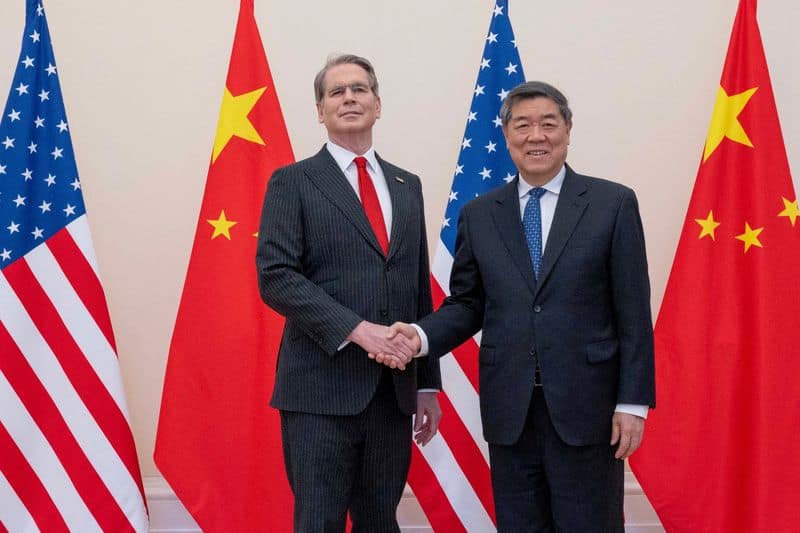
- US Treasury Secretary Scott Bessent and Chinese Vice Premier He Lifeng will meet Sunday to discuss AI, tariffs, and critical minerals.
- The meetings are intended to prepare for a summit between US President Donald Trump and Chinese President Xi Jinping.
- Key topics include the expiring US-China trade truce, critical mineral flows, and AI security.
- Analysts expect incremental steps to avoid escalating tensions rather than major breakthroughs.
- Previous agreements included pledges for China to increase US agricultural purchases and buy more Boeing aircraft.
- China's performance on restoring critical mineral flows to the US has been deemed "not up to par" by a senior US official.
US Treasury Secretary Scott Bessent and Chinese Vice Premier He Lifeng are scheduled to meet on Sunday in New York to lay the groundwork for potential agreements on artificial intelligence, trade tariffs, and critical minerals ahead of a high-stakes summit between US President Donald Trump and Chinese President Xi Jinping later this week. The meetings, also including US Trade Representative Jamieson Greer, will take place at JP Morgan Chase's headquarters and are expected to last all day.
Key discussion points will include the status of the US-China trade truce, which is set to expire on November 10, the flow of Chinese rare-earth magnets and critical minerals, and potential guard rails for artificial intelligence following reports of security breaches. Analysts suggest the most likely outcome will be small steps to de-escalate tensions, rather than significant breakthroughs, given the delicate state of the trade relationship.
These discussions follow a pattern of preparatory meetings between the three officials in various global cities over the past 16 months. Previous efforts led to agreements such as the November 2025 truce that capped US tariffs on Chinese goods. The Trump administration has been rebuilding tariffs under new authorities, including a 12.5% tariff related to forced labor allegations and an ongoing investigation into excess industrial capacity in China.
Under a prior truce, China had pledged to restore the flow of critical minerals, but a senior US official indicated that China's performance has been insufficient and will be a topic of discussion. The talks on AI are significant as both countries are major drivers of AI development, with rare earths being crucial for AI-powered semiconductor technology. Bessent expressed openness to discussing AI risks and avoiding bifurcation of systems, while also calling for "guard rails" to prevent powerful AI models from falling into the wrong hands.
Additionally, the US and China agreed in May to discuss reducing tariffs on non-strategic goods and to establish a forum for investment issues. While the US has tightened restrictions on investments in China, it is reportedly considering rules that would permit US pharmaceutical firms to invest in and license Chinese drugs. China's Ministry of Commerce announced that He would also lead a business delegation to the US for economic and trade consultations.