Key facts
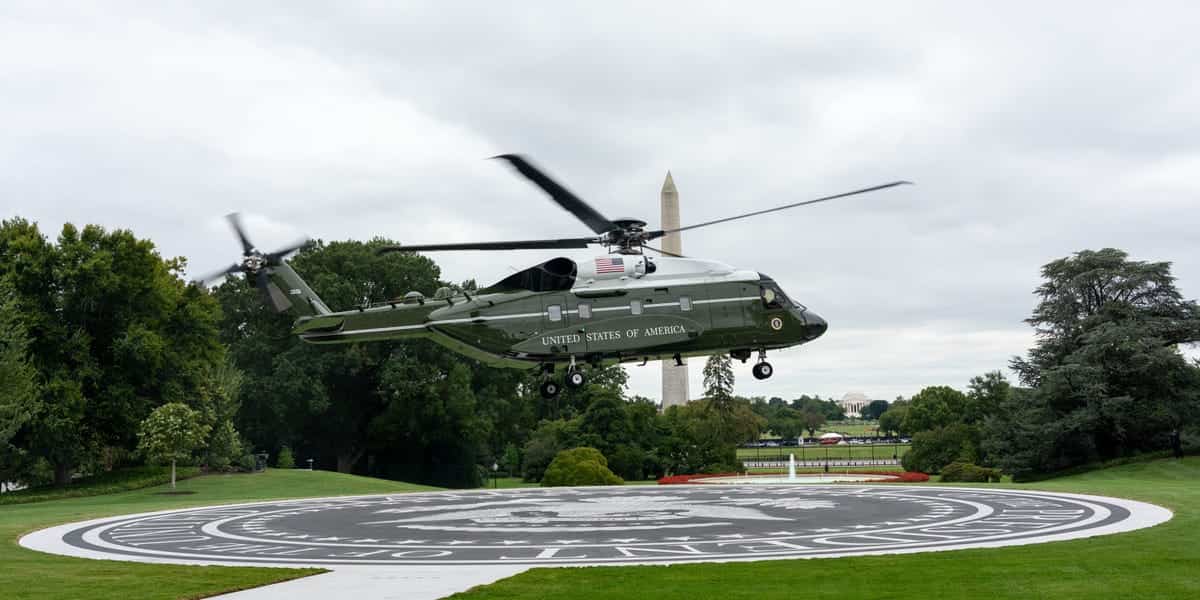
- President Donald Trump took his first public flight from the new White House helipad on Monday.
- The helipad was funded by Sikorsky Aircraft, a subsidiary of Lockheed Martin.
- The helipad cost between $5 million and $6 million.
- The new helipad is intended to protect the South Lawn's grass from damage caused by more powerful presidential helicopters.
- The VH-92A Patriot is the new model for presidential transport.
President Donald Trump made his first public departure from the White House via Marine One on Monday, utilizing a newly constructed helipad on the South Lawn. The $6 million helipad was funded by Sikorsky Aircraft, a subsidiary of Lockheed Martin, to accommodate the more powerful new fleet of presidential helicopters.
Trump stated that the helipad was necessary because the newer VH-92A Patriot helicopters are significantly more powerful than the previous fleet and could damage the South Lawn's grass upon landing. He also mentioned that Sikorsky felt "a little bit guilty" for not initially disclosing the helicopters' power, leading to their funding of the helipad.
The helipad, which bears the White House seal, cost between $5 million and $6 million. Construction faced a setback when Trump ordered portions of the work redone, including dismantling a nearly 100-foot-wide granite seal. During construction, Marine One used the Ellipse, a park south of the White House, as its landing zone.
Historically, aviation pioneer James Ray landed an autogyro on the South Lawn in 1931, marking the first recorded instance of a rotary-wing aircraft landing there. President Dwight D. Eisenhower was the first US president to use helicopter transport from the White House lawn in 1957, significantly reducing travel time compared to motorcades.