Key facts
- Communication issues occurred between air traffic control and Marine One before a passenger jet came too close.
A preliminary report from the National Transportation Safety Board revealed communication issues between Marine One and air traffic control prior to a passenger jet getting too close to President Donald Trump's helicopter. Construction at the White House was cited as a contributing factor.
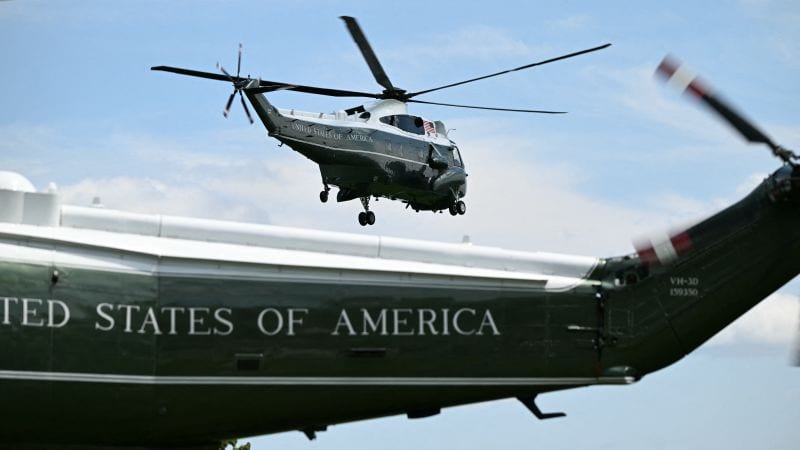
The incident highlights potential vulnerabilities in presidential air travel safety due to communication breakdowns and infrastructure work, prompting immediate corrective actions by the FAA.
Communication issues between air traffic control and Marine One occurred just before a passenger jet came too close to the helicopter carrying President Donald Trump. A preliminary report from the National Transportation Safety Board (NTSB) released on Thursday indicated that ongoing construction at the White House played a role in the incident.
The NTSB's seven-page report detailed that there was insufficient line-of-sight between the radio transmitter/receiver site and The Ellipse, where Marine One was temporarily operating due to White House construction. Marine One made two failed attempts to contact Ronald Reagan Washington National Airport's air traffic control tower; the first transmission was not received at all, and the second was broken and unreadable.
Earlier this month, planes continued to take off as Marine One, with President Trump onboard, lifted off from the Ellipse. An American Airlines regional jet briefly entered the protective bubble around the helicopter. Typically, flights are halted from the nearby airport when the president is taking off.
The Federal Aviation Administration (FAA) stated after the incident that there was a "momentary loss of separation" but reaffirmed that the president was never in danger. White House spokesperson Kush Desai expressed confidence in the pilots and security officials, noting that work continues to ensure the President's safety.
Transportation Secretary Sean Duffy confirmed the issue as a telecommunications problem, stating that teams are working to resolve it. The FAA reported taking immediate action after the August 4th incident, including relocating an antenna to improve communications between DCA air traffic controllers and Marine One pilots, and reviewing procedures.
Pick the topics you care about. Get only what matters, on your cadence.