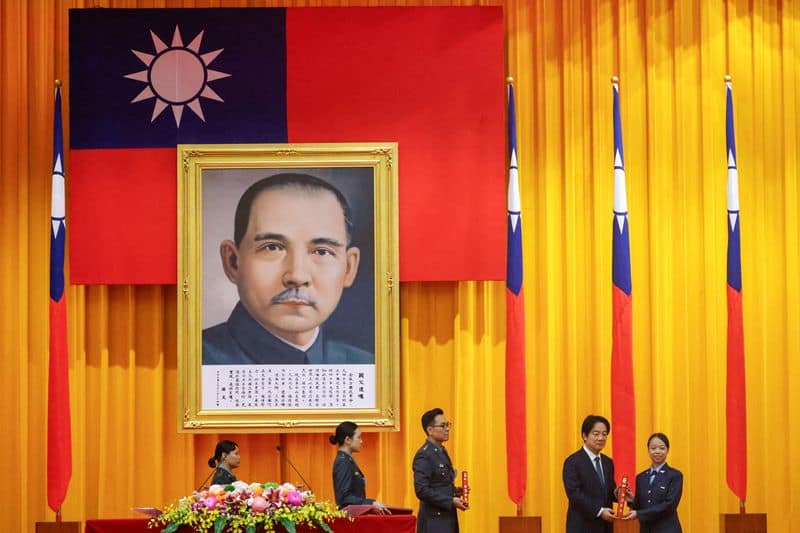
Taiwan is actively countering what it perceives as Beijing's attempts to distort the historical narrative of World War Two, particularly following a summit where Chinese President Xi Jinping and US President Donald Trump emphasized their countries' wartime alliance. Taipei is concerned that this historical framing could erode US support for the island, which China claims as its territory.
Taiwan asserts that during World War Two, the Republic of China was the legitimate government fighting alongside the Allies. This government relocated to Taiwan in 1949 after losing a civil war to Mao Zedong's communists.
In contrast, Beijing's historical accounts often downplay the role of Republican forces, emphasizing the contributions of communist guerrilla fighters. At a state dinner in Washington, both Xi and Trump recalled the US and China fighting together in the war, with a White House fact sheet noting they "fought side by side to win the war."
Shen Yu-chung, deputy head of Taiwan's Mainland Affairs Council, stated that Xi is "continuously trying to guide the World War Two historical narrative to be led by the People's Republic of China." He added that Taiwan would continue to inform the US to ensure a "correct understanding" of the Republic of China's role as America's ally. Taiwan's Deputy Foreign Minister Francois Wu expressed sadness over China's efforts to overwrite "true history."
Last year, the de facto US embassy in Taipei accused China of spreading "false" World War Two narratives to pressure Taiwan. Chen Fang-yu, an associate professor at Taipei's Soochow University, noted the challenge Taiwan faces in combating China's narratives to a US audience, citing China's "enormous propaganda resources."