Key facts
- Bone fragments from the sword hand of medieval Russian prince Dmitry Donskoy have been sent to the front in Ukraine.
- The Russian Orthodox Church stated the relic was dispatched to bolster the spirits of Russian troops.
- Donskoy, who defeated the Mongol Golden Horde in 1380, was declared a saint in 1988.
- The relic is being shown to Russian combat units along the 1,000-km front line.
- Sergei Kiriyenko, Putin's first deputy Kremlin chief of staff, participated in a ceremony in Donetsk involving the relic.
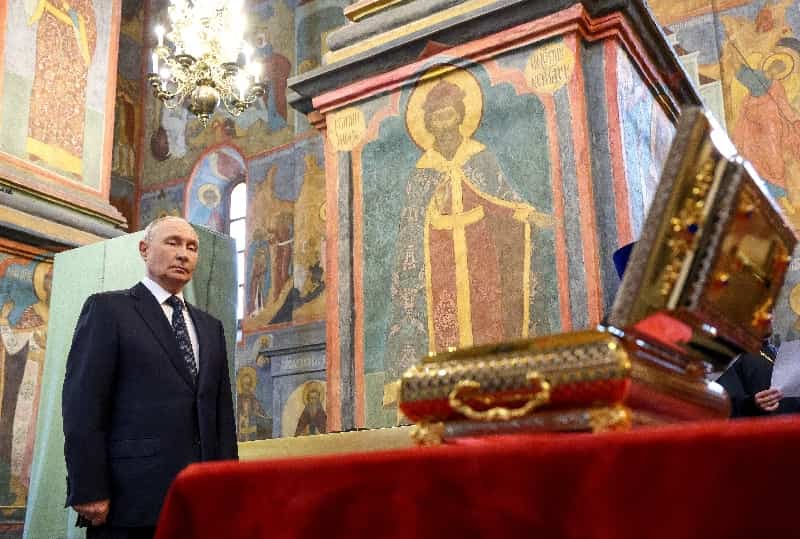
Bone fragments from the sword hand of Grand Prince Dmitry Donskoy, a medieval Russian prince revered for his victory over the Mongols at the 1380 Battle of Kulikovo, have been sent to the front lines in Ukraine. The Russian Orthodox Church stated the relic was dispatched to bolster the spirits of Russian troops fighting in the conflict, presenting it as a symbol of divine support for Russia's military operation. Donskoy, who died in 1389, was declared a saint by the Russian Orthodox Church in 1988. His remains were recently uncovered during restoration work at Moscow's Cathedral of the Archangel inside the Kremlin. President Vladimir Putin personally inspected the remains in August, calling it a "unique and marvellous discovery." The relic, housed in an ornate casket, is being shown to Russian combat units along the more than 1,000-km front line. This effort is seen as a public relations exercise to boost patriotism and morale ahead of a parliamentary election. Russian military and church officials have presented the discovery as a sign that God is on Russia's side. At a ceremony in Donetsk, Sergei Kiriyenko, Putin's first deputy Kremlin chief of staff, participated in a ritual involving the relic. Metropolitan Vladimir of Donetsk and Mariupol, a senior Moscow-appointed cleric, stated that military personnel and residents of Donbas need divine help. The Defence Ministry also released footage of troops attending a church service with icons and Orthodox flags. However, critics have accused the Church of breaking religious protocol to please the Kremlin and questioned the timing of the relic's recovery and veneration. Alexander Zanemonets, an Orthodox priest and historian, suggested the move was an attempt by the Church leadership to demonstrate support for the war, noting that priests had already been sent to the front lines and prayers for victory instituted.