Key facts
- Quad ministers pledged to build reliable global supply chains.
- Concerns were raised regarding economic coercion and arbitrary export restrictions.
- The group emphasized protecting navigational rights in the Strait of Hormuz, Red Sea, and Bab el-Mandeb Strait.
- Over $85 million pledged to support trusted AI technologies in the Indo-Pacific.
- A new effort will be launched to identify semiconductor supply chain vulnerabilities.
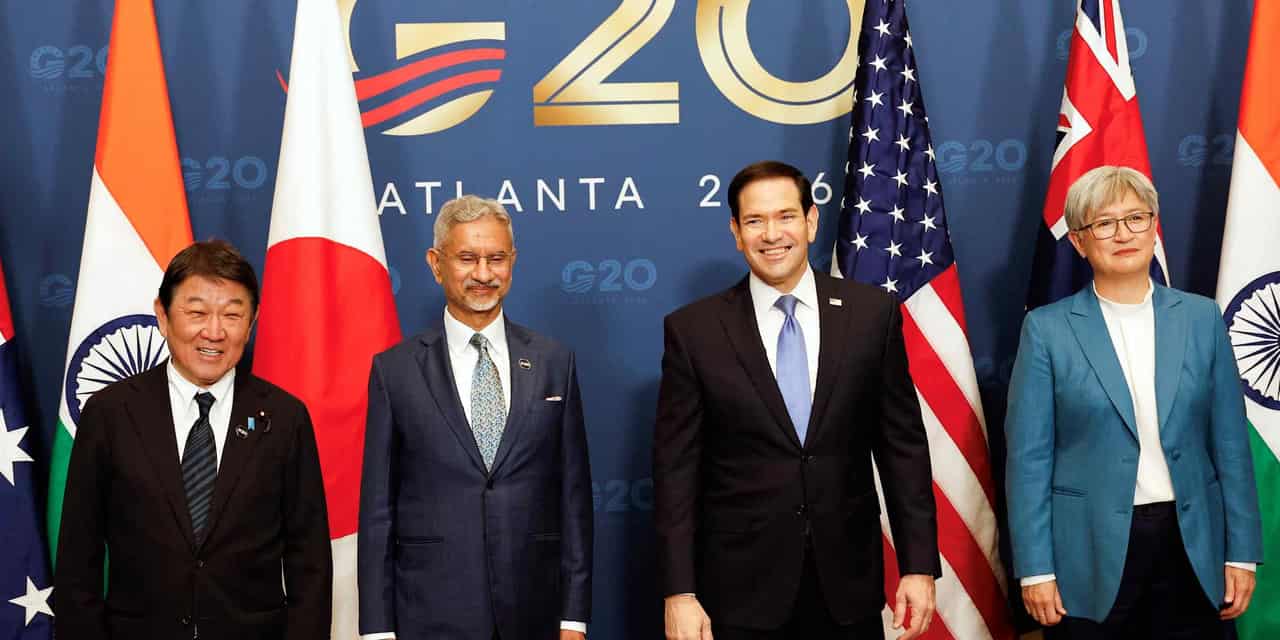
Foreign ministers from the U.S., Australia, India and Japan met in Atlanta, Georgia, on Saturday, pledging to work on building reliable global supply chains and expressing concerns about economic coercion through export restrictions. The joint statement by the Indo-Pacific "Quad" also emphasized the necessity of protecting navigational rights and freedoms in the Strait of Hormuz, the Red Sea, and the Bab el-Mandeb Strait. The group pledged over $85 million in assistance to support trusted artificial intelligence technologies across the Indo-Pacific region and will launch a new effort to identify vulnerabilities in semiconductor and related supply chains. U.S. Secretary of State Marco Rubio stated the Quad is not an "anti-China or anti-anybody coalition," but aims to address concerning behaviors and activities. Plans are also taking shape for U.S. President Donald Trump to attend his first formal meeting of the Quad leaders next month in Manila.