Key facts
- North Korea appears "flustered" by South Korea's findings on a DMZ mine blast and subsequent mine-clearing.
- South Korea's Joint Chiefs of Staff Chairman Gen. Jin Yong-sung called the mine blast a "provocation" by North Korea.
- The blast on Sept. 21 injured three South Korean soldiers, two seriously.
- An investigation confirmed antipersonnel mines deliberately planted by Pyongyang caused the blast.
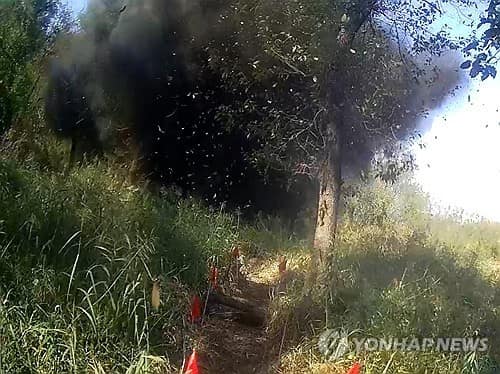
- South Korean troops conducted a mine-removal operation at the blast site.
South Korea's defense minister stated that North Korea appears "flustered" by Seoul's findings blaming Pyongyang for a mine blast near the inter-Korean border and the subsequent mine-clearing operation.
Gen. Jin Yong-sung, Chairman of South Korea's Joint Chiefs of Staff (JCS), described the Sept. 21 blast as a "provocation" by North Korea, vowing to review response measures. He made these remarks during a parliamentary audit, acknowledging that the term "provocation" had not been explicitly used in an earlier military announcement.
The JCS, in conjunction with the U.N. Command, concluded its investigation, confirming that resin antipersonnel mines deliberately planted by Pyongyang south of the Military Demarcation Line (MDL) caused the explosion, which left three South Korean soldiers injured, two critically.
In response, the South Korean military initiated an operation to remove any remaining land mines at the blast site, marking the first such mission within the buffer zone between the two Koreas. The military also pledged to bolster its readiness posture to deter future provocations and to respond "sternly" to the damage inflicted on its troops, including through both physical and nonphysical means. Future plans include enhancing capabilities for operations in the Demilitarized Zone (DMZ) and accelerating the transition of surveillance systems to AI-driven platforms.