Key facts
- India hosts the BRICS summit this week amid divisions over the U.S.-led war on Iran.
- The conflict has caused crude oil prices to exceed $100 a barrel.
- The UAE suspended trade with Iran after being hit by Iranian missiles.
- Disagreements between Iran and the UAE threaten a joint declaration at the summit.
- Chinese President Xi Jinping and Russian President Vladimir Putin are expected to attend.
- BRICS has expanded to include Egypt, Ethiopia, Iran, the UAE, and Indonesia.
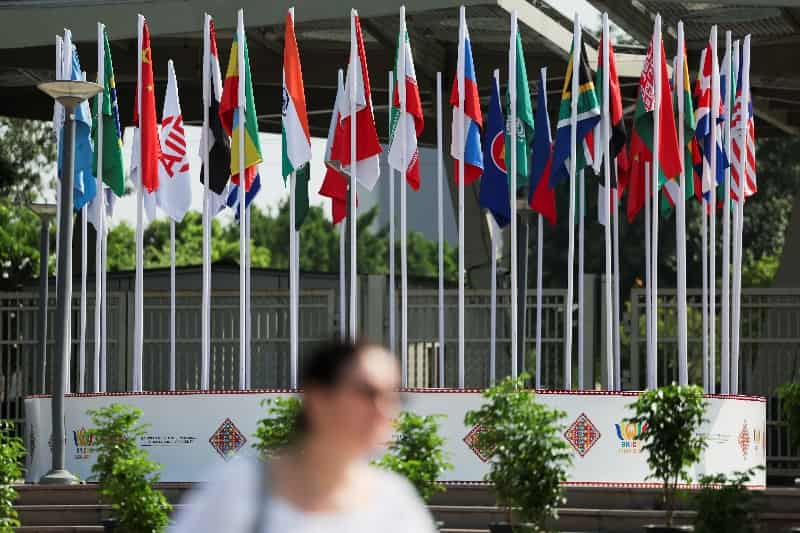
India is hosting the BRICS Leaders' Summit this week, aiming to enhance the bloc's global influence. However, the ongoing U.S.-led war on Iran, a BRICS member since 2024, has created significant divisions within the group, particularly between Iran and the UAE, which has suspended trade with Tehran after being targeted by Iranian missiles. The conflict has also driven crude oil prices above $100 a barrel.
Foreign policy experts suggest that the success of the summit hinges on finding language on the Middle East crisis that is acceptable to both Abu Dhabi and Tehran, which would allow for a joint declaration. While such a statement might not alter the geopolitical landscape, it could demonstrate the unity of emerging economies against economically damaging policies like Western sanctions. Chinese President Xi Jinping's attendance, his first visit to India in seven years, underscores Beijing's commitment to BRICS and places China and India at the forefront of efforts to maintain bloc cohesion.
Other leaders expected include Russian President Vladimir Putin, Iran's Masoud Pezeshkian, South Africa's Cyril Ramaphosa, Egypt's Abdel Fattah al-Sisi, and Indonesia's Prabowo Subianto. The UAE will be represented by Abu Dhabi Crown Prince Sheikh Khaled bin Mohamed bin Zayed Al Nahyan. Saudi Arabia's Foreign Minister Faisal bin Farhan Al Saud will also attend, though the kingdom's full membership remains ambiguous.
Kremlin spokesman Dmitry Peskov acknowledged that the differences between the UAE and Iran negatively impact the drafting of a joint declaration but expressed hope for a mutually acceptable phrasing. The expansion of BRICS to include Egypt, Ethiopia, Iran, the UAE, and Indonesia reflects its growing appeal, but divergent views among new members could potentially reduce its effectiveness, according to Michael Kugelman of the Atlantic Council. A similar attempt to issue a joint statement in May by BRICS foreign ministers failed due to these differences. However, a recent joint declaration at the Shanghai Cooperation Organisation (SCO) summit, which condemned the U.S.-Israeli campaign against Iran and Western sanctions, offers a potential template for BRICS. Experts also note that U.S. protectionist policies may encourage BRICS countries to strengthen their cooperation.