All NewsEducationTVBrokers
Equities & FundsCrypto & Digital AssetsAI & TechnologyBusiness & CorporateUS Politics & PolicyGeopolitics & Global RiskMacro, Rates & FXCommodities & EnergyEuropean Politics & MarketsAsia-PacificReal Estate & Property
All NewsHome
← Back to Geopolitics & Global Risk

Haiti gangs expand operations into rural areas, report says

Created at 7 Sep · 5:06 PM1 source↑ Market-relevant
IN SHORT

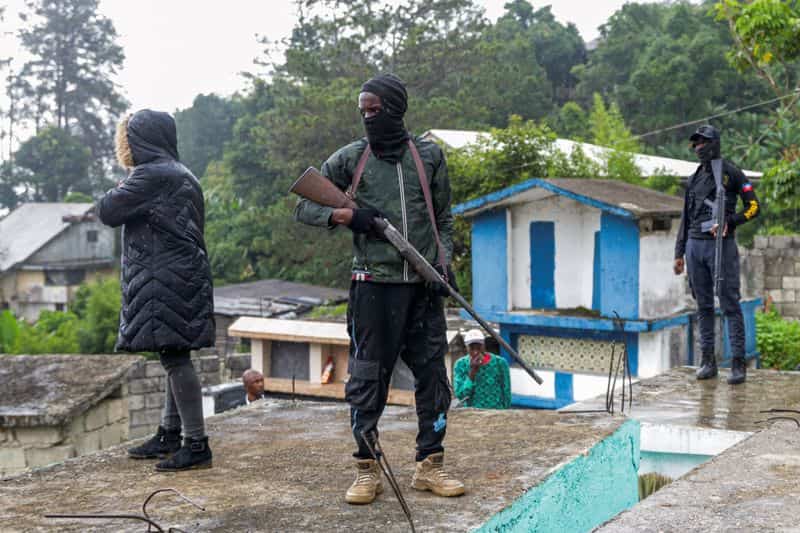
Haitian gangs are increasingly moving from the capital into rural areas, employing hit-and-run tactics like kidnappings and roadblocks, according to a new report. The shift poses significant challenges for security forces and requires broader measures beyond just security responses.

Who's Involved

Global Initiative Against Transnational Organized Crime's Haiti Observatory
published the report on gang operations
Kenscoff
mountainous community outside Port-au-Prince targeted by gangs
Artibonite
agricultural region experiencing worsening insecurity
Haiti gangs expand operations into rural areas, report says

↳ Why This Matters

The expansion of gang violence into Haiti's rural areas threatens food security, exacerbates displacement, and challenges the capacity of the state to provide basic security and economic stability, potentially leading to further humanitarian crises.

Key facts

  • Haitian gangs are increasingly operating in rural areas outside the capital, Port-au-Prince.
  • These gangs are employing hit-and-run tactics, including kidnappings, cattle theft, and roadblocks.
  • A report highlights the attack on Kenscoff, a mountainous community, as an example of changing gang violence.
  • Insecurity is worsening in Artibonite, a major agricultural region, with gangs targeting communities and farmland.
  • Haitian security forces are described as lacking the necessary resources to counter mobile armed groups.
  • The report calls for a comprehensive approach including protecting farmers, restoring local economies, and addressing land disputes, alongside disarmament efforts.

Haitian gangs are increasingly shifting their operations from the capital, Port-au-Prince, into rural areas, adopting hit-and-run tactics such as kidnappings, cattle theft, and roadblocks, according to a new report. The analysis by the Global Initiative Against Transnational Organized Crime's Haiti Observatory suggests this is more than an extension of urban gang activity.

The report details how gangs are utilizing small, mobile units for rapid raids, community harassment, and movement between areas that serve as both sanctuaries and targets. This approach allows armed groups to project influence and disrupt daily life without needing to occupy territory permanently.

The recent assault on Kenscoff, a mountainous community near Port-au-Prince, which resulted in dozens of deaths and a mass kidnapping, is cited as an example of this evolving nature of gang violence. The report also points to escalating insecurity in Artibonite, one of Haiti's primary agricultural regions, where gangs have been targeting communities, transportation routes, and farmland.

This growing violence in rural areas presents a significant challenge for Haiti's security forces, who are reportedly lacking adequate personnel, equipment, and training to effectively combat highly mobile armed groups across difficult terrain. The report emphasizes that a purely security-focused response would be insufficient. It advocates for broader measures, including protecting farmers, revitalizing local economies, and addressing long-standing land and community disputes, in conjunction with efforts to disarm and reintegrate gang members.

Frequently asked questions

Gangs are using small, mobile units for rapid raids, kidnappings, cattle theft, and establishing roadblocks.

Artibonite, a major agricultural region, is experiencing increased gang violence targeting communities and farmland.

The report indicates they lack sufficient personnel, equipment, and training to counter mobile armed groups in dispersed, mountainous terrain.

It calls for protecting farmers, restoring local economies, addressing land disputes, and disarming/reintegrating gang members.

What Happens Next

01Haitian authorities are expected to consider the report's recommendations for a multi-faceted approach.
02International partners may reassess aid strategies based on the evolving security landscape.

How It Developed

Haitian gangs are expanding operations from Port-au-Prince into rural areas.
Gangs are using small, mobile units for rapid raids and to move between sanctuaries and targets.
An attack on Kenscoff involved dozens of deaths and a mass kidnapping.
Insecurity is worsening in Artibonite, a key agricultural region.
Haitian security forces lack personnel, equipment, and training for dispersed terrain.
A security response alone is insufficient, requiring measures to protect farmers and restore economies.

Sources

T1
Haiti gangs shift operations into countryside, report saysReuters

Related Stories

Bolivia military base explosion kills 7, dozens injured
7 Sep · 3:52 PM
Berlin substation fire probed amid string of German grid attacks
7 Sep · 8:13 AM
UN expert warns Gaza rubble clearance may destroy evidence of war crimes
7 Sep · 4:10 PM
Philippines defense chief: China may exploit US-SK exercise cuts
7 Sep · 4:27 AM
UAE building alternative trade routes amid Iran conflict
7 Sep · 8:48 AM