Key facts
- China's auto and appliance sales declined sharply in June.
- Government subsidies for cars, air conditioners, and televisions were phased out.
- The sales slump indicates weak consumer sentiment in China.
China's auto and appliance sales saw a significant drop in June following the expiration of government subsidies, signaling weak consumer sentiment and prompting calls for new economic stimulus. Meanwhile, Chinese automakers, spearheaded by BYD, achieved a historic milestone in May 2026 by outselling Japanese brands in European passenger car sales for the first time. This surge is linked to robust international sales and the UK's open market policies, even as the EU imposes tariffs on electric vehicles.
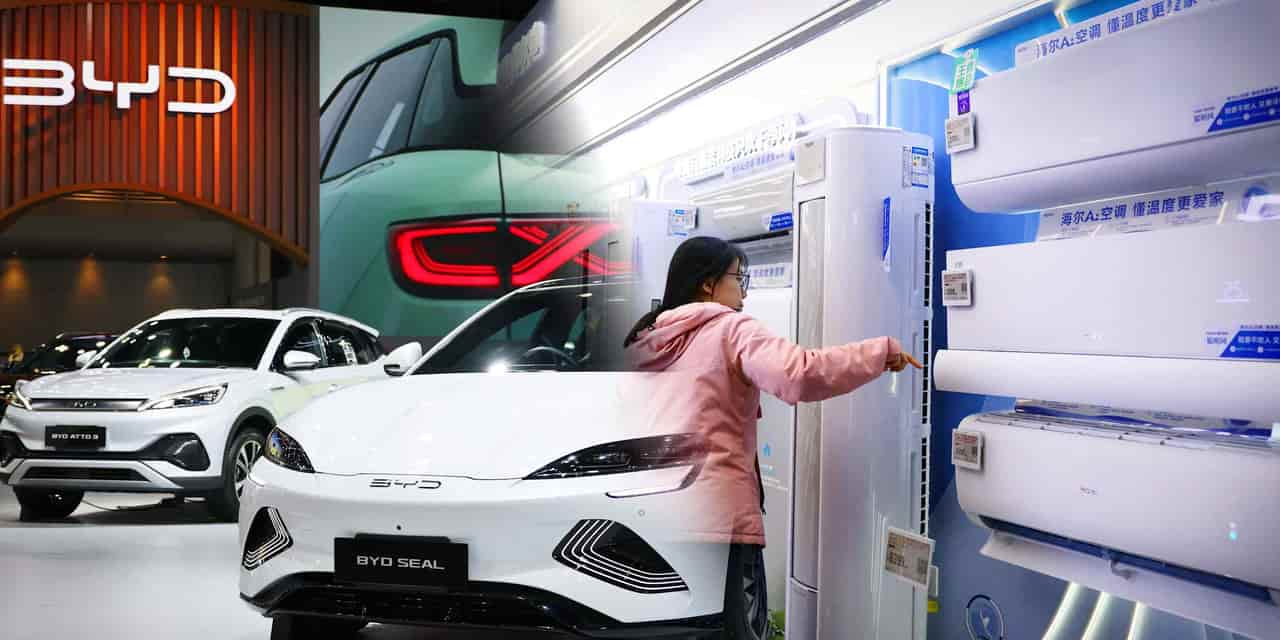
Sales of key consumer goods in China, including automobiles, air conditioners, and televisions, experienced a sharp decline in June. This downturn is directly attributed to the phasing out of government subsidies that had previously boosted demand. The slump has intensified pressure on Chinese policymakers to introduce new stimulus measures to counteract weakening consumer sentiment and support the broader economy. The automotive sector, in particular, is facing headwinds as domestic demand falters.
In a separate but related development within the automotive industry, Chinese car manufacturers have achieved a significant milestone in the European market. In May 2026, Chinese automakers, with BYD leading the charge, surpassed their Japanese counterparts in passenger car sales within Europe for the first time. This surge in European sales is driven by strong overseas performance from these Chinese brands. The UK's open market policy is also cited as a contributing factor to this success. However, this achievement occurs against the backdrop of the European Union's imposition of tariffs on electric vehicles, which could present future challenges for Chinese automakers operating in the bloc.
The contrast between the domestic sales slump and the international success highlights the diverging fortunes of China's automotive sector. While domestic demand is being hampered by the withdrawal of subsidies and broader economic concerns, Chinese manufacturers are demonstrating increasing competitiveness on the global stage. The success in Europe, particularly in surpassing established Japanese rivals, underscores the growing influence of Chinese brands in the international automotive landscape, especially in the electric vehicle segment.
Sales of key consumer goods in China, including automobiles, air conditioners, and televisions, experienced a sharp decline in June. This downturn is directly attributed to the phasing out of government subsidies that had previously boosted demand. The slump has intensified pressure on Chinese policymakers to introduce new stimulus measures to counteract weakening consumer sentiment and support the broader economy. The automotive sector, in particular, is facing headwinds as domestic demand falters.