HomeEverything
Equities & FundsCrypto & Digital AssetsAI & TechnologyBusiness & CorporateUS Politics & PolicyGeopolitics & Global RiskMacro, Rates & FXCommodities & EnergyEuropean Politics & MarketsAsia-PacificReal Estate & Property
← All Stories

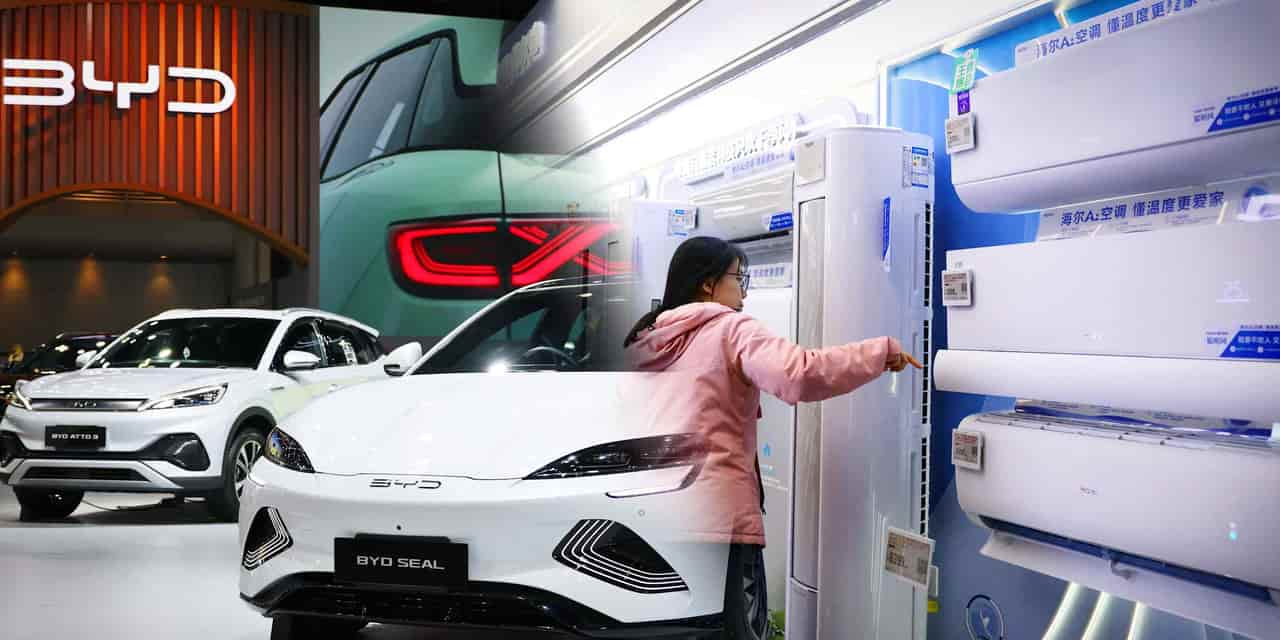
China Auto, Appliance Sales Slump as Subsidies Fade

Created at 2 Jul · 6:21 AM1 source↑ Market-relevant
IN SHORT

Sales of cars, air conditioners, and televisions in China experienced a sharp decline in June as government subsidies were phased out. This downturn is increasing pressure on policymakers to implement new stimulus measures to support the economy, which is showing weak consumer sentiment.

✉Newsletter

PiQ Daily

Pick your topics. Get only what matters, on your cadence.

Key Numbers

25%year-on-year drop in China auto sales (Jan-Feb 2026)
27.5%year-on-year drop in China NEV sales (Jan-Feb 2026)
48.4%year-on-year surge in China auto exports (Jan-Feb 2026)
4.1 millionvehicle sales generated by trade-in subsidies in 2025
20,000 yuancapped rebate for NEV scrappage under new rules
15,000 yuancapped rebate for ICE vehicle scrappage under new rules
5%purchase tax for NEVs capped at 15,000 yuan
45.5%NEV penetration in China (first 8 months of 2025)
36.7%year-on-year sales increase for NEVs (first 8 months of 2025)
12.6%overall vehicle sales growth in China in 2025
10-15%estimated lower NEV adoption without subsidies
950,000units of passenger cars sold in China in February 2026

Who's Involved

BYD
automaker that lost top sales position
SAIC Motor
automaker that took top sales position
CAAM
China Association of Automobile Manufacturers
Chen Shihua
official at CAAM forecasting recovery
Nio
automaker focusing on high-margin segments
William Li
CEO of Nio
Tesla
automaker offering price incentives
Chery
top auto exporter in 2025
Leapmotor
automaker starting Spain plant
Geely
automaker pursuing joint ventures
China Auto, Appliance Sales Slump as Subsidies Fade

↳ Why This Matters

The sharp decline in sales of major consumer goods like cars and appliances due to subsidy withdrawal signals weak consumer sentiment, increasing pressure on Chinese policymakers to implement stimulus measures and potentially deepening the economy's reliance on exports.

Key facts

  • China's auto market experienced a significant downturn in early 2026, with domestic sales dropping nearly 25% year-on-year in January-February.
  • New energy vehicle (NEV) sales fell 27.5% in the same period.
  • Exports of vehicles surged 48.4% year-on-year, driven by international NEV demand.
  • The downturn is attributed to policy shifts in trade-in subsidies, with new 2026 rules focusing on price-based rebates.
  • Automakers are responding with promotions, upgrades, and increased exports.
  • Sales of cars, air conditioners, and TVs fell rapidly in China in June 2026 as government subsidies faded.

China's automotive market experienced a significant downturn in early 2026, with domestic sales dropping nearly 25% year-on-year in January-February to 2.8 million units. New energy vehicle (NEV) sales also fell 27.5% to 1.1 million units during the same period, largely due to reduced government subsidies. This decline saw BYD lose its top sales position to SAIC Motor.

The downturn stems from policy shifts in trade-in subsidies, which had previously fueled over 4.1 million vehicle sales in 2025. New rules for 2026 introduced price-based rebates, with capped amounts for NEV and internal combustion engine (ICE) vehicle scrappage, and a new 5% purchase tax for NEVs ending full exemptions. Automakers are responding to the domestic sluggishness with promotions, upgrades, and a strong focus on exports, which surged 48.4% year-on-year, driven by international NEV demand.

Industry optimism from 2025 has shifted to concern over these incentive changes, leading firms to focus on higher-margin models and technological upgrades. Some automakers are targeting high-margin segments like large SUVs, while others, like Tesla, have offered price incentives such as low-interest loans to boost retail growth. Long-term innovation in electronics is also being eyed for growth, with companies like BYD launching faster charging technology and expanding fast-charging infrastructure.

Exports are fueling global shifts, with companies like Chery, the top exporter in 2025, expanding overseas production. BYD aims for significant overseas sales growth with new plants in Thailand, Brazil, Hungary, and Turkey. Leapmotor is starting a plant in Spain, and Geely is pursuing joint ventures in markets like Brazil.

Regional subsidy suspensions, such as in Jiangsu Province from September 28, 2025, have accelerated the pullback. Many regions have shifted from open applications to limited voucher systems, tightening eligibility and reflecting depleted funds. This subsidy withdrawal introduces uncertainty, testing the resilience of an industry accustomed to policy support. The true demand drivers are expected to emerge as these supports recede, potentially spurring industry consolidation and favoring established automakers over subsidy-dependent players. Consumers are likely to become more price-sensitive, impacting overall market dynamics.

Frequently asked questions

Sales dropped due to the reduction and phasing out of government subsidies for electric vehicles and trade-in programs.

Companies focused on higher-margin models, technological upgrades, price incentives like loans, and increased exports.

Domestic sluggishness may persist for a few more months before recovery, potentially leading to industry consolidation and a greater focus on market-driven growth.

Subsidies were instrumental in boosting NEV adoption, with analysts estimating adoption rates could have been 10-15% lower without them.

What Happens Next

01Domestic sluggishness in the auto market may last 1-2 more months before recovery via new models.
02Automakers are expected to continue focusing on higher-margin segments and technological upgrades.
03Further stimulus measures from Chinese policymakers are anticipated to support the economy.

Get the newsletter.

Pick the topics you actually care about. We'll email when there's news worth your time, on the cadence you choose. Cancel any time from your account.

Cadence

How It Developed

China's auto market saw a significant downturn in early 2026.
Domestic auto sales dropped nearly 25% year-on-year in January-February 2026.
NEV sales fell 27.5% in January-February 2026 due to reduced government subsidies.
BYD lost its top sales position to SAIC Motor in early 2026.
Exports of vehicles surged 48.4% year-on-year, offsetting domestic weakness.
Provincial subsidy withdrawals, such as in Jiangsu, accelerated in late 2025.
China's domestic passenger car sales fell sharply in February 2026 from a year earlier.
Sales of cars, air conditioners, and TVs fell rapidly in China in June 2026.

Sources

T1
China faces policy test as subsidy pullback hits auto, appliance salesNikkei Asia
T2
Chinese auto sales plunge in February on weak demand | AP Newsapnews.com
T2
In Depth: China Auto Market Hits the Brakes After Subsidy Cutscaixinglobal.com
T2
China's Automotive Market at a Crossroads: Navigating the Subsidy Phase ...yuantrends.com

Related Stories

BYD's first-half sales fall 16% amid China EV market slowdown
1 Jul · 2:35 PM
Chinese automakers surpass Japanese rivals in Europe
2 Jul · 8:00 AM
BYD Sales Increase for Second Month, Driven by Exports
1 Jul · 10:23 AM
China's EV makers set sales records with new tech
2 Jul · 6:05 AM
China's New Economy Gauge Rises in June
2 Jul · 4:06 AM