Key facts
- Chinese President Xi Jinping visited Egypt and called for a new Middle East security framework.
- Xi Jinping urged Middle Eastern nations to oppose external interference.
- China and Egypt are expanding their partnership into technology, defense, and strategic cooperation.
- The two countries are conducting their second joint air force exercise.
- Bilateral trade between China and Egypt increased by 21.5% year-on-year in the first half of 2026.
- Xi Jinping and Egyptian President Abdel Fattah el-Sisi issued a joint statement emphasizing the Palestinian question as central to Middle East issues.
- The joint statement supported the establishment of an independent State of Palestine based on 1967 borders with East Jerusalem as its capital.
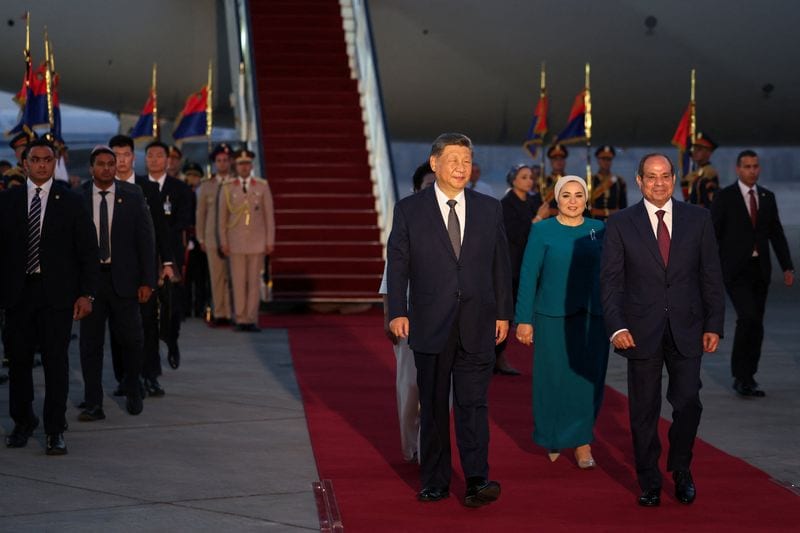
Chinese President Xi Jinping's visit to Egypt signifies a deepening of ties between the two nations, extending beyond infrastructure and trade into technology, defense, and a broader strategic partnership with regional implications. During his visit, Xi urged Middle Eastern countries to oppose external interference and explore a new security architecture, a stance that contrasts with perceived US entanglement in the region.
This visit marks Xi's first trip to Cairo since 2016, coinciding with the 70th anniversary of diplomatic relations. Chinese companies have significantly contributed to Egypt's landscape, including the construction of the New Administrative Capital's central business district, featuring Africa's tallest building, the Iconic Tower. A light rail system and a China-Egypt industrial zone near the Suez Canal, hosting over 200 companies, further illustrate this economic cooperation, with Chinese figures reporting over $4.7 billion in investment and more than 10,000 direct jobs created.
The economic agenda is expanding to include AI, advanced manufacturing, and technology transfer. A five-year program (2024-2028) aims for local production and technology transfer in sectors like electric vehicles, electronics, solar panels, and AI. Egypt seeks Chinese investment in EVs, battery storage, renewable energy, and shipbuilding, alongside enhanced technology transfer.
Defense ties are also becoming more prominent, with China and Egypt conducting their second joint air force exercise, 'Eagles of Civilisation.' While the US remains Egypt's primary security partner, these exercises reflect Egypt's policy of diversifying its defense partnerships. China's engagement with US partners in the Middle East and Africa has previously raised concerns in Washington.
Bilateral trade reached $11.3 billion in the first six months of 2026, a 21.5% increase year-on-year. Egyptian exports to China nearly tripled, driven by fuel, minerals, fruits, vegetables, and cotton. However, imports from China, primarily machinery, electrical equipment, vehicles, and steel, reached $10.4 billion.