All NewsEducationTV
Equities & FundsCrypto & Digital AssetsAI & TechnologyBusiness & CorporateUS Politics & PolicyGeopolitics & Global RiskMacro, Rates & FXCommodities & EnergyEuropean Politics & MarketsAsia-PacificReal Estate & Property
All NewsHome
← Back to AI & Technology

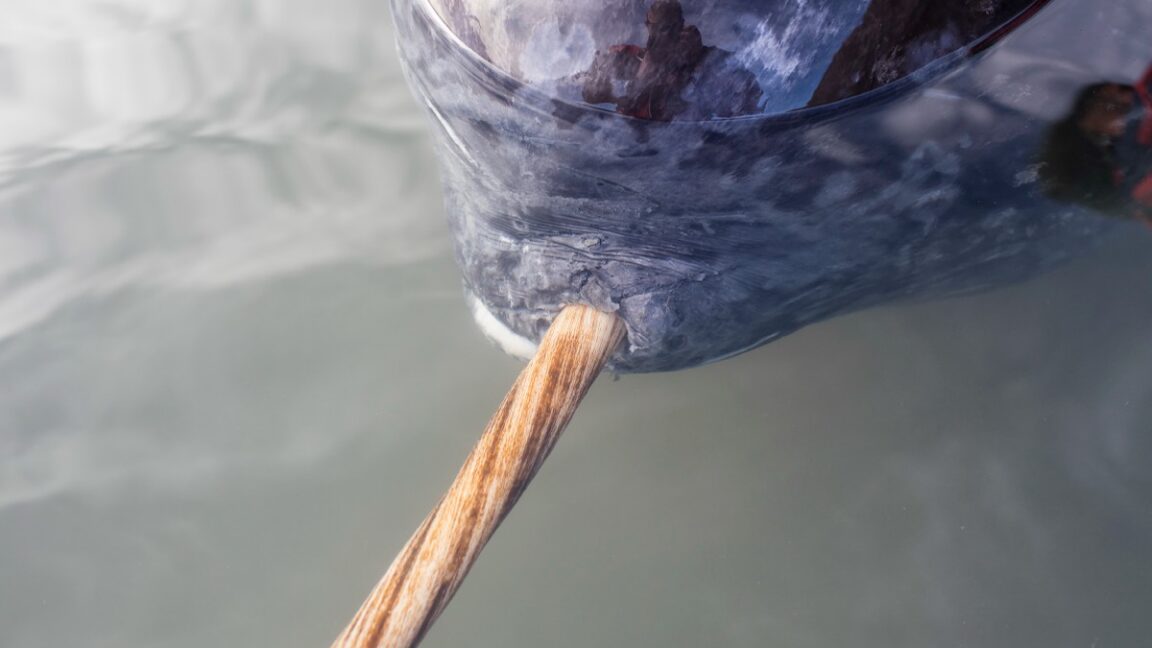
X-rays reveal narwhal tusks have double spiral structure

Created at 18 Aug · 3:11 PM1 source↑ Market-relevant
IN SHORT

New research using advanced X-ray imaging techniques has uncovered that narwhal tusks possess a double-helix structure, with an internal spiral twisting in the opposite direction to the external one. This unique composition contributes to the tusk's exceptional stiffness and strength.

Key Numbers

1.5 to 2 metersnarwhal tusk length

Who's Involved

Jennifer Ouellette
Senior Writer
Mads Peter Heide-Jørgensen
Greenland Institute of Natural Resources
Adrian Rodriguez Palomo
Researcher
Henrik Birkedal
Co-author from Aarhus University
X-rays reveal narwhal tusks have double spiral structure

↳ Why This Matters

The discovery of a double-helix structure in narwhal tusks provides new insights into the biomechanics and evolutionary adaptations of these unique marine mammals, potentially influencing future biomimicry applications in material science.

Key facts

  • Narwhal tusks have a previously unknown internal spiral structure.
  • The tusk's structure is a double helix, with opposing spiral directions in the cementum and dentine layers.
  • This unique composition provides the tusk with remarkable stiffness and strength.
  • Advanced X-ray imaging techniques were used to map the tusk's structure at multiple scales.
  • The findings suggest the tusk's structure allows it to grow straight.

A new study published in Nature Communications reveals that narwhal tusks, long known for their single left-handed spiral, actually possess a complex double-helix structure. Researchers utilized advanced imaging techniques, including X-ray computed tomography and bifringence microscopy, on two male narwhal tusk specimens. The findings indicate that while the outer cementum layer exhibits a left-handed spiral, the inner dentine layer forms a right-handed spiral. This unique structural arrangement is believed to be responsible for the tusk's exceptional stiffness and strength, enabling it to withstand significant bending and twisting forces without cracking and allowing it to grow straight. Scientists are also exploring the potential of narwhal tusks as historical records of environmental changes, given the presence of nerve endings and their role in sensing water conditions.

Frequently asked questions

A narwhal tusk is actually a canine tooth in the left upper jaw of male narwhals, which pushes through the lip and can grow to lengths of 1.5 to 2 meters.

The new research reveals that narwhal tusks have a double-helix structure, with an internal spiral twisting in the opposite direction to the external one.

This structure provides the tusk with remarkable stiffness and strength, allowing it to withstand strong forces like bending and twisting without cracking.

The study combined X-ray computed tomography, scanning X-ray diffraction, scanning small-angle X-ray scattering, tensor tomography, and bifringence microscopy.

What Happens Next

01Researchers plan to further study the microstructure in the cementum using micro- and nano-beam experiments.
02The team will investigate whether narwhal tusks can serve as historical records of changing environmental conditions.

How It Developed

A new study analyzed two male narwhal tusk and skull specimens.
Researchers combined multiple advanced imaging techniques, including X-ray computed tomography and bifringence microscopy.
The study found that narwhal tusks have a double-helix structure.
The external cementum layer forms a left-handed helix, while the internal dentine forms a right-handed helix.
This double-helix structure contributes to the tusk's stiffness and strength, allowing it to withstand forces without cracking.

Sources

T1
X-rays add new twist to narwhal’s spiral tuskvar abtest_2167752 = new ABTest(2167752, 'impression');Ars Technica

Related Stories

SpaceX recovers damaged Starship from Indian Ocean
18 Aug · 7:06 PM
NASA images show crater from SpaceX rocket impact on moon
18 Aug · 10:06 PM
Chinese doctors enable double-thigh amputee to walk with advanced prosthetics
18 Aug · 1:05 PM
Microsoft Copilot vulnerability allowed data exfiltration via URL prompts
18 Aug · 1:06 PM
Walmart workers train AI, correct errors as retailer expands tech use
18 Aug · 10:31 AM