Key facts
- SpaceX caught the Starship upper stage with the launch tower's mechanical arms at Starbase, Texas, on November 14, 2026.
- The upper stage flew 14 orbits over more than 22 hours before returning to the pad, Reuters reported.
- The Super Heavy booster failed to return to the pad about 10 minutes after liftoff on November 13, 2026.
- SpaceX has not recovered both Starship stages in a single mission, Reuters reported.
- Starship's heat shield of black hexagonal tiles is not yet fully reusable, Reuters reported.
- SpaceX's Falcon 9 rocket has launched more than 700 times since 2010, Reuters reported.
SpaceX recovered the Starship upper stage at its launch tower in Starbase, Texas, on November 14, 2026, the first recovery of the rocket system's centerpiece vessel, Reuters reported. Two mechanical arms on the tower clasped the spacecraft as it hovered in place.
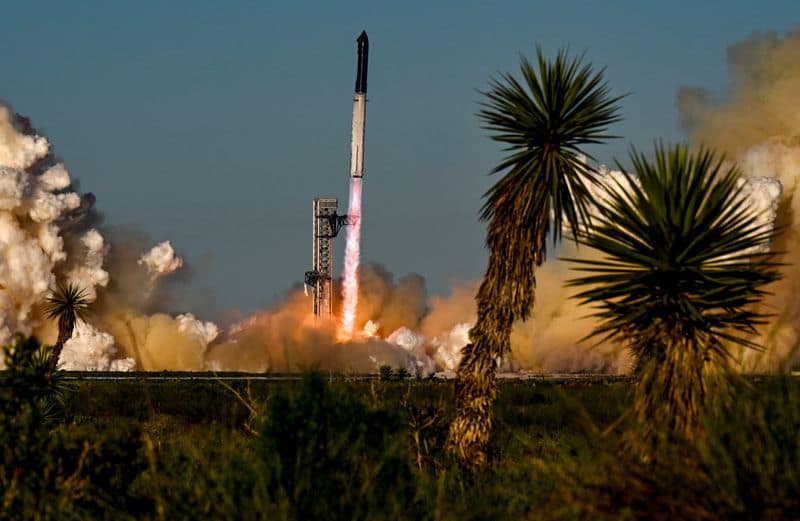
The Super Heavy booster, the rocket's lower half, carried Starship to space on November 13, 2026. That booster failed to return to the launch pad about 10 minutes after liftoff, ending SpaceX's plan to recover both parts of the rocket for the first time. SpaceX spokesperson Dan Huot said the guidance, navigation and control system detected the booster was not in position for a catch and triggered the abort.
Starship orbited Earth 14 times over more than 22 hours. It deployed 26 Starlink satellites on the night of November 13 while cruising at an altitude of about 161 miles, then fired one engine on November 14 to begin its atmospheric plunge. Its orbital speed of about 17,000 miles per hour slowed to a supersonic free-fall before it reignited three engines to flip vertical and steer toward the tower.
SpaceX's launch business rests on the Falcon 9 rocket, which has launched more than 700 times since 2010. Its first stage is reusable, but its second stage is discarded into the ocean after each flight. Elon Musk wants a rocket system that can fly to space and back in a manner and tempo akin to commercial airplanes.
SpaceX has yet to recover both Starship stages in a single mission, and the heat shield of black hexagonal tiles that protects the spacecraft on reentry is not yet fully reusable. The company is working on new tile designs that would require little to no refurbishment after each mission. NASA's Space Shuttle, retired in 2011, was partially reusable and needed extensive refurbishment before re-flying.