Key facts
- Grzegorz Braun leads the Confederation of the Polish Crown, polling at around 9%.
- President Karol Nawrocki hosted Braun at the Presidential Palace on October 31 for consultations.
- Jaroslaw Kaczynski suggested Braun's camp could join a joint right-wing list for the 2027 race.
- Braun's party runs on a complete halt to all military and financial aid to Ukraine.
- The Confederation Liberty and Independence polls third at around 14%, narrowing the gap with PiS.
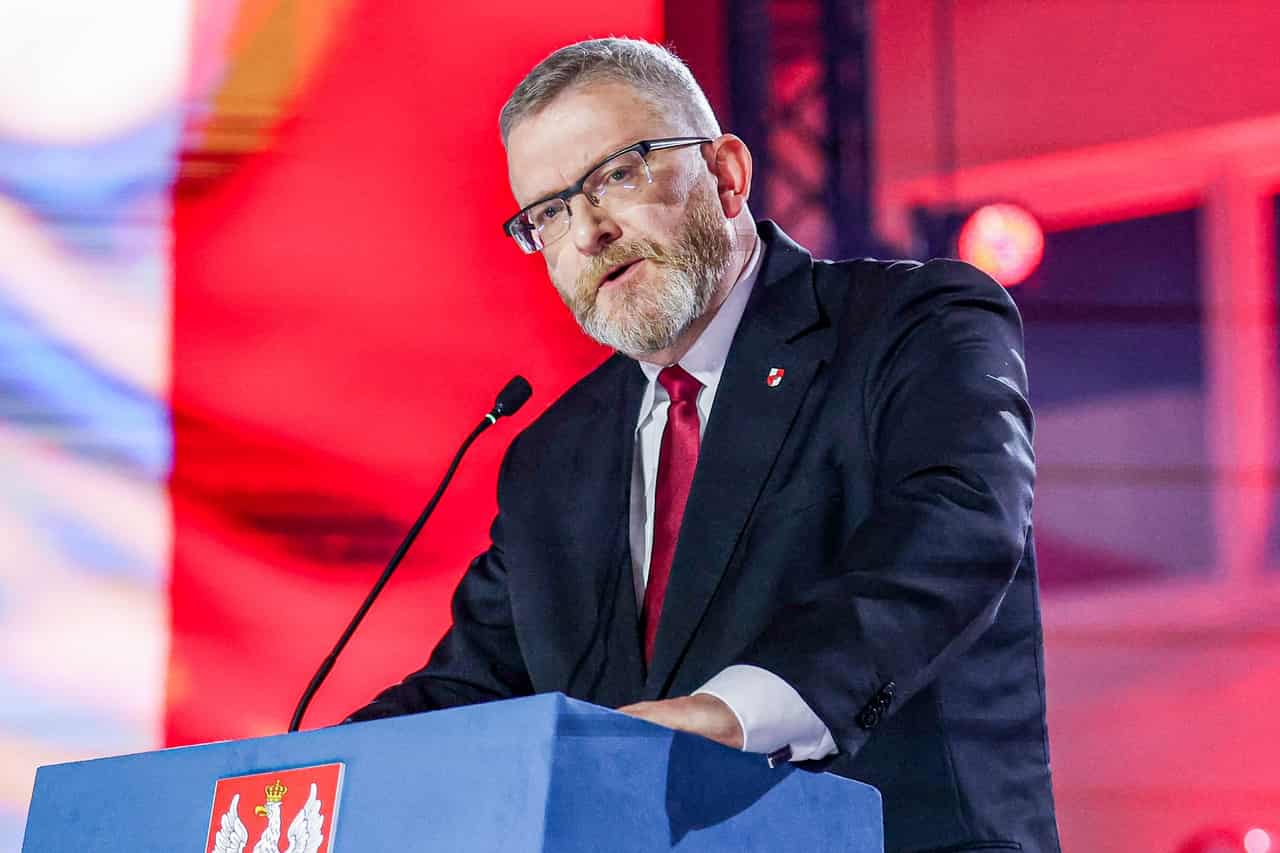
Grzegorz Braun, leader of the far-right Confederation of the Polish Crown (KKP), is being courted by leading right-wing politicians as they seek to unite ahead of the 2027 parliamentary elections, according to a report published November 17, 2026. Braun, a Moscow-friendly provocateur facing multiple charges for his antisemitic, anti-LGBT, and anti-Ukrainian stunts, leads the KKP, which is polling at around 9%.
Conservative President Karol Nawrocki appears to be playing a central role in efforts to bring the factions closer together. He hosted KKP representatives at the Presidential Palace on October 31 for consultations amid the Constitutional Tribunal crisis, and included them in high-level security discussions. Just a few days later, Wlodzimierz Skalik from Braun's party took part in a meeting of the National Security Council at Nawrocki's invitation, despite the government's protests. "We can't pretend that Grzegorz Braun and Grzegorz Braun's voters don't exist in Poland," Nawrocki said, stressing he "radically disagrees" with him on several issues.
In a notable departure from his previous position, Jaroslaw Kaczynski, leader of the Law and Justice (PiS) party, has suggested that Braun's political camp could be included on a joint right-wing electoral list for the 2027 parliamentary race. During Poland's Independence March on November 11, Kaczynski called for a united list not only for the Senate elections but also for the more powerful lower house, the Sejm. "Representatives of the three Confederations must be convinced," the PiS leader said, seemingly referring to the two parties making up the Confederation and to Braun's KKP.
Behind the scenes, Nawrocki has reportedly been negotiating an alliance for next year's Senate elections, spanning the entire right: PiS, the Confederation, Morawiecki's Development Plus, and Braun. The so-called "Senate Pact" would prevent right-wing parties from splitting the vote in a single-member, first-past-the-post election for the upper chamber of the Polish parliament.
"Undoubtedly, this is driven by calculations regarding next year's elections," said Michal Lebduska, a research fellow at the Prague-based Association for International Affairs (AMO) think tank. "Nawrocki has repeatedly stated that Donald Tusk's government is the worst in Poland's history and must be removed from power at any cost." Wojciech Przybylski, an editor at Visegrad Insight and president of Res Publica Nowa, added that the president "has no other political objective than getting rid of Donald Tusk."
The challenge to Nawrocki's alliance-making is the fragmentation of the Polish right and the long-standing distrust many have toward Braun. The Confederation, which kicked Braun out in 2025, has kept the door open to working with him in the future. But Kaczynski, long used to holding a grip over the right, had been vocal about his opposition to such an alliance. He previously warned it would endanger Poland's security and accused the far-right leader of "crossing civilization bounds." That reluctance seems to be fading.
Braun's radical agenda includes a complete halt to all military and financial aid to Ukraine, and his party's five-point "Ukraine Plan" includes "immediate repairs, inspection, and maintenance" at the Rzeszow airport, which would effectively disrupt a key transport hub for military aid flowing to Ukraine. Braun has also railed against Ukrainian refugees and what he calls the "Ukrainization of Poland." He has called for the resumption of Russian gas supplies to Europe via the now-defunct Nord Stream pipelines, and has publicly backed Tehran's leadership after the U.S.-Israeli strikes.