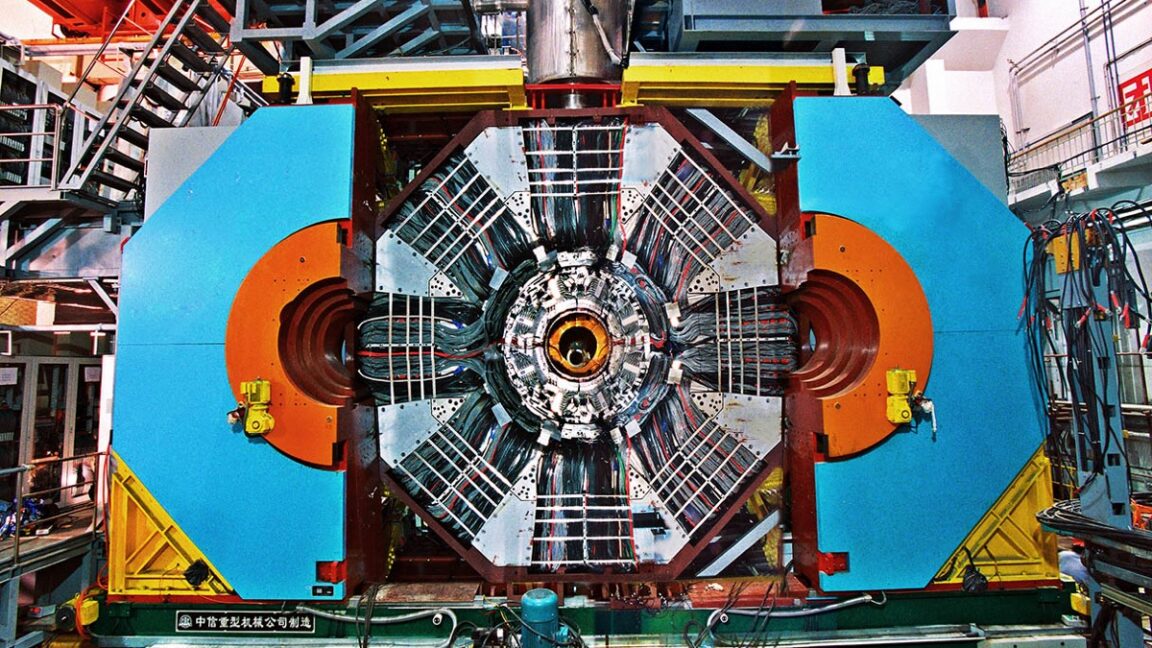
Key facts
- Physicists with the Beijing Spectrometer III (BES III) experiment have found new evidence for glueballs.
- Glueballs are composite particles predicted by quantum theory, made entirely of gluons.
- Gluons are the carriers of the strong nuclear force that bind quarks together.
- Most of the mass of protons and neutrons comes from the energy of the gluons holding them together.
- A potential glueball must have zero spin, no electric charge, and odd parity.
Physicists working with the Beijing Spectrometer III (BES III) experiment have announced compelling new evidence for the existence of glueballs, theoretical composite particles composed solely of gluons. These particles are a direct prediction of quantum chromodynamics, the theory governing the strong nuclear force.
Gluons are fundamental to the structure of matter, acting as the force carriers that bind quarks into protons and neutrons. While the Higgs boson explains how fundamental particles acquire mass, a significant portion of the mass of protons and neutrons originates from the immense energy of the gluons binding them together, as described by Einstein's E=mc².
The search for glueballs has long focused on the decay of J/ψ particles, discovered in 1974. These mesons, composed of a charm quark and antiquark, decay into numerous gluons and other hadrons, providing a fertile ground for detecting glueball signatures. According to astrophysicist Ethan Siegel, specific properties such as zero spin, no electric charge, and odd parity are considered indicators of a potential glueball.