All NewsEducationTVBrokers
Equities & FundsCrypto & Digital AssetsAI & TechnologyBusiness & CorporateUS Politics & PolicyGeopolitics & Global RiskMacro, Rates & FXCommodities & EnergyEuropean Politics & MarketsAsia-PacificReal Estate & Property
All NewsHome
← Back to AI & Technology

NASA's Roman Telescope Launched to Study Dark Energy and Dark Matter

Created at 31 Aug · 1:06 PM1 source↑ Market-relevant
IN SHORT

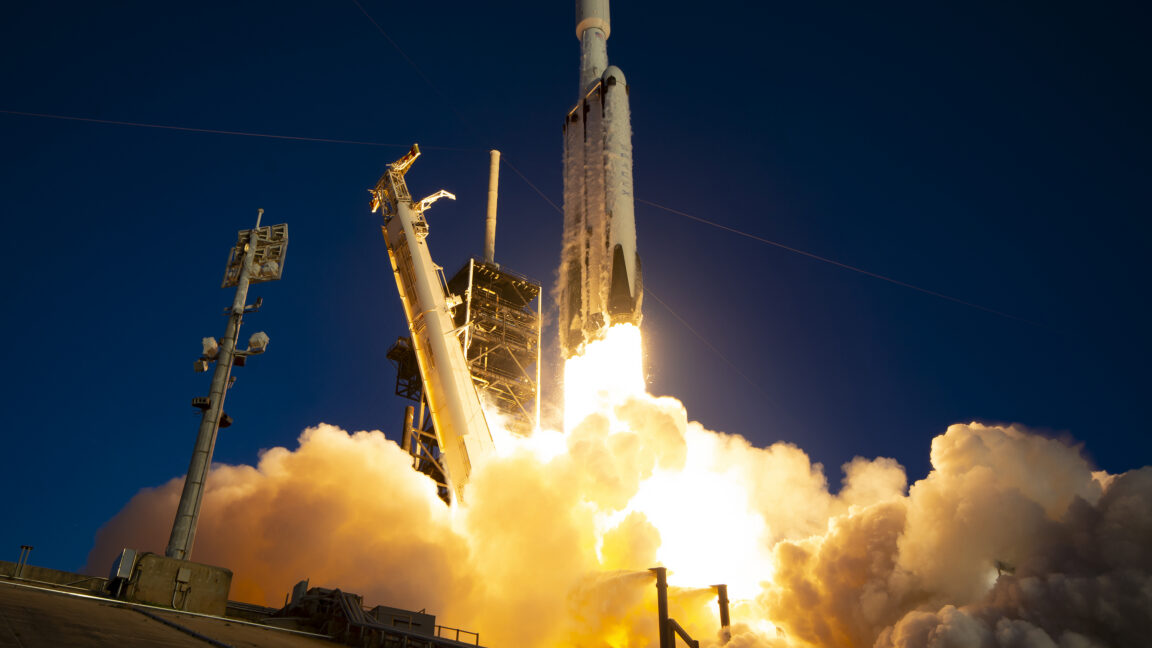
NASA's Nancy Grace Roman Space Telescope, a $4.3 billion observatory, has launched on a SpaceX Falcon Heavy rocket. It aims to study dark energy and dark matter, offering a field of view 100 times wider than the Hubble Space Telescope.

Key Numbers

$4.3 billioncost of Roman Space Telescope
300-megapixelcamera resolution
100 timeswider field of view than Hubble
2021year Webb Space Telescope launched
May 2027NASA's commitment deadline for launch
7:25 am EDT (11:25 UTC)launch time
27main engines on Falcon Heavy
four timesfarther from Earth than the Moon
20,000 pounds (9 metric tons)fully fueled telescope weight
1.5 million kilometersdistance to L2 point
three monthstime to reach operational orbit
7.9-foot-diameter (2.4-meter)primary mirror size
2012year NASA took possession of NRO spy telescopes
12 percentof the sky Roman will survey
0.1 percentof the sky Hubble observed
1,000 timesfaster survey speed than Hubble
70 percentof cosmos is dark energy

Who's Involved

NASA
Agency that launched the Nancy Grace Roman Space Telescope
Nancy Grace Roman
NASA's first chief astronomer, after whom the telescope is named
SpaceX
Company that launched the telescope on a Falcon Heavy rocket
Jared Isaacman
NASA Administrator
Denton Gibson
NASA's launch director for the Roman mission
Julie McEnery
Senior project scientist for the Roman telescope at NASA’s Goddard Space Flight Center
Nicky Fox
Head of NASA’s Science Mission Directorate
National Reconnaissance Office
Provided the telescope's primary mirror
NASA's Roman Telescope Launched to Study Dark Energy and Dark Matter

↳ Why This Matters

The launch of the Nancy Grace Roman Space Telescope marks a significant advancement in astronomical observation, promising to deepen our understanding of fundamental cosmic mysteries like dark energy and dark matter, and potentially reshape our understanding of the universe's composition and evolution.

Key facts

  • NASA's Nancy Grace Roman Space Telescope, costing $4.3 billion, launched Sunday from Kennedy Space Center.
  • The telescope was launched aboard a SpaceX Falcon Heavy rocket.
  • Roman's mission is to study dark energy and dark matter, and to provide a field of view 100 times wider than the Hubble Space Telescope.
  • The observatory is named after Nancy Grace Roman, NASA's first chief astronomer.
  • It uses a 7.9-foot-diameter telescope mirror originally built for a US government spy satellite.
  • The telescope is expected to discover tens of thousands of new planets and billions of galaxies.

NASA's Nancy Grace Roman Space Telescope, a $4.3 billion observatory, successfully launched Sunday from Kennedy Space Center in Florida aboard a SpaceX Falcon Heavy rocket. The mission aims to expand our understanding of the universe, particularly focusing on dark energy and dark matter.

The Roman telescope boasts a field of view 100 times wider than the Hubble Space Telescope and is designed to complement the James Webb Space Telescope's work. It is the second NASA-led astrophysics mission launched this century, following Webb in 2021. Unlike Webb, Roman was delivered to the launch pad ahead of schedule.

NASA Administrator Jared Isaacman praised the mission as a success story for the agency, highlighting its timely and on-budget completion. He stated that Roman will provide a new atlas of the universe and push the boundaries of discovery.

The SpaceX Falcon Heavy rocket lifted off at 7:25 am EDT from Launch Complex 39A. The observatory, weighing approximately 20,000 pounds fully fueled, was deployed on a trajectory to reach the Sun-Earth L2 Lagrange point, nearly a million miles from Earth. The launch director noted the flawless performance of the Falcon Heavy.

Roman will take about three months to reach its operational orbit, during which ground teams will activate and calibrate the observatory. Scientists expect the first science images to be ready by the end of the year.

The mission is named after Nancy Grace Roman, NASA's first chief astronomer and a key advocate for space-based telescopes, including Hubble. The observatory's primary mirror, measuring 7.9 feet in diameter, was originally built for a US government spy satellite and donated to NASA by the National Reconnaissance Office. Engineers spent nearly a decade adapting the mirror for Roman's specific optical needs and operating temperatures.

Nicky Fox, head of NASA’s Science Mission Directorate, described Roman as a versatile telescope capable of surveying 12 percent of the sky, significantly more than Hubble. Roman is anticipated to discover tens of thousands of new planets, billions of galaxies, and tens of billions of stars, operating at a speed approximately 1,000 times faster than Hubble.

Cosmologists are particularly interested in Roman's potential to shed light on dark energy, believed to constitute about 70 percent of the universe and drive its accelerated expansion, and dark matter, which makes up over a quarter of the cosmos. The telescope's discoveries may also challenge the current Standard Model of the Universe.

Frequently asked questions

The telescope's primary goals are to study dark energy and dark matter, and to survey a large portion of the sky to discover new celestial objects.

Roman has a field of view 100 times wider than Hubble and can survey the sky about 1,000 times faster.

The primary mirror was originally built for a US government spy satellite and was donated to NASA, saving significant development time and cost.

Scientists expect to have the first science images ready for publication by the end of the year, following a three-month transit and calibration period.

What Happens Next

01Roman will take approximately three months to reach its operational orbit at the L2 point.
02Ground teams will activate and calibrate the observatory during its transit.
03Scientists aim to have the first science images ready for publication by the end of the year.

How It Developed

NASA's Nancy Grace Roman Space Telescope launched on a SpaceX Falcon Heavy rocket.
The telescope is designed to study dark energy and dark matter.
Roman's field of view is 100 times wider than the Hubble Space Telescope.
The mission is named after Nancy Grace Roman, NASA's first chief astronomer.
The telescope utilizes a refurbished spy mirror from the National Reconnaissance Office.
Roman is expected to discover tens of thousands of new planets and billions of galaxies.
Scientists anticipate the first science images to be ready by the end of the year.

Sources

T1
NASA’s next “great observatory” begins mission to widen our view of the Universevar abtest_2169742 = new ABTest(2169742, 'impression');Ars Technica

Related Stories

CLASSy World: Reimagining Blended Learning in the Metaverse
30 Aug · 4:06 PM
Massive 12TB Steam data leak reveals lost PC gaming history
30 Aug · 9:46 PM
US Army To Spend $2.2B On Nuclear Microreactors For Military Bases
31 Aug · 3:26 AM
China launches space-computing hub amid US rivalry
31 Aug · 9:36 AM
EU places ChatGPT, Reddit, Roblox under strict Digital Services Act rules
31 Aug · 10:12 AM