Key facts
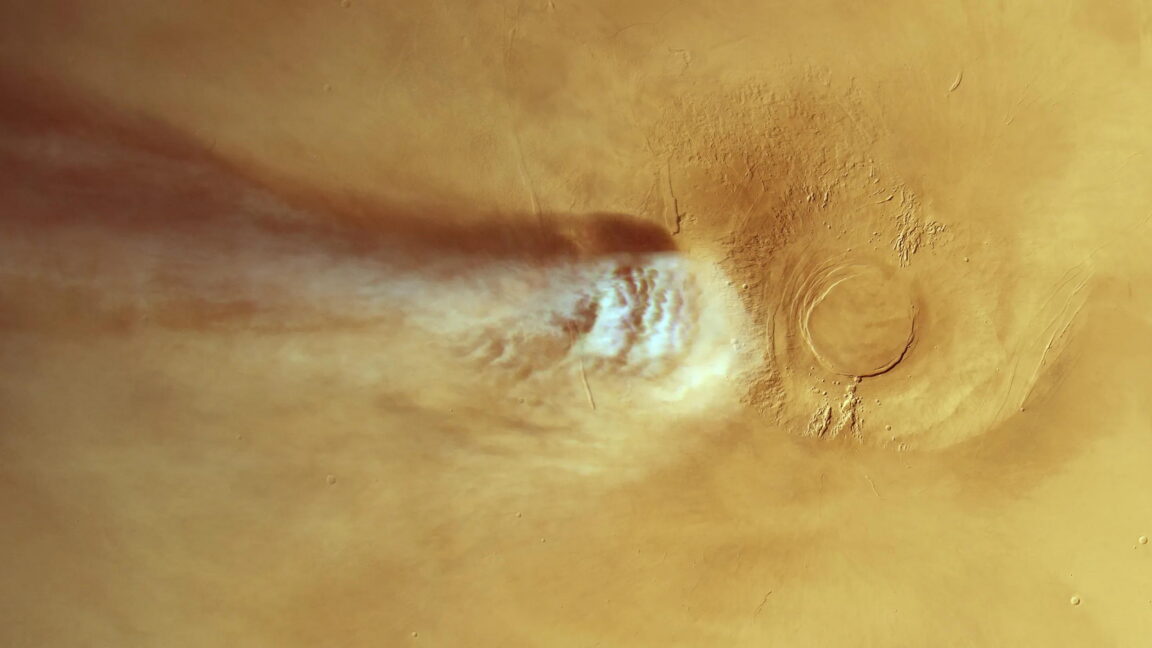
- A 1,000-mile cloud near Mars' Arsia Mons volcano has been successfully modeled.
- The cloud's formation may involve homogeneous nucleation, where vapor turns directly into ice crystals without debris.
- This process requires extreme conditions: a 30°C temperature drop in 10 minutes and very high relative humidity.
A long, wispy cloud that appears daily near the Arsia Mons volcano on Mars, stretching over 1,000 miles, has been a scientific mystery since it was first recorded in 2018. Researchers have now successfully modeled its formation, suggesting it is driven by a physical process called homogeneous nucleation. This phenomenon, where vapor changes directly into ice crystals without the help of particles like dust or salt, has never been directly observed in nature before. The study, published in Nature Geoscience, indicates that the cloud's formation requires extreme conditions, including a rapid temperature drop and very high relative humidity, which are facilitated by the volcano's topography.