Key facts
- The Zorawar weighs about 25 tonnes in base configuration; added armour could raise that by roughly seven tonnes.
- The Indian Army wants STANAG Level 6 protection against 30 mm APFSDS kinetic energy rounds for the Zorawar.
- The Zorawar's 760 horsepower engine is a US-origin Cummins unit, one of several imported subsystems.
- The tank's 105 mm main gun was developed by Belgian-origin John Cockerill, and its thermal sight is imported from France's Safran.
- The Indian Army plans a first production tranche of 59 Zorawar tanks, with induction targeted for 2027.
- Tata Advanced Systems was the lowest bidder and Mahindra Defence Systems second for competing light tank prototypes.
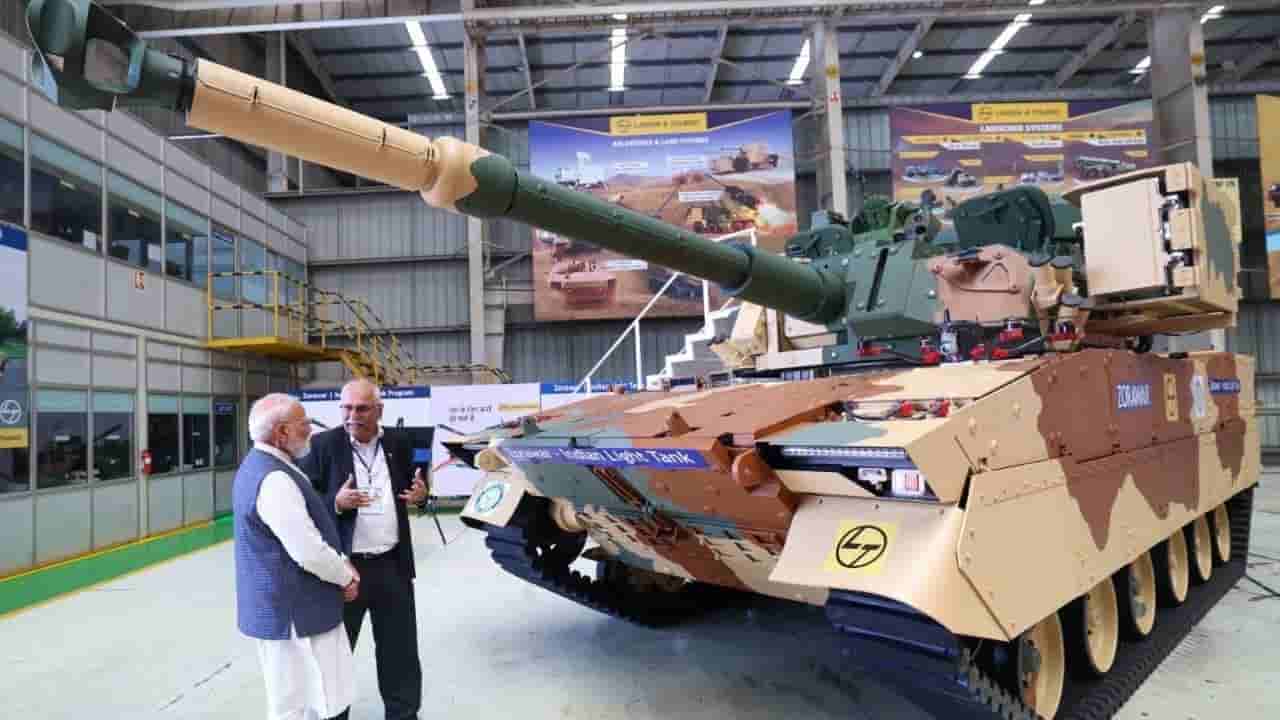
India's Zorawar light tank was designed for the thin air, narrow roads and small bridges along the disputed border with China, where heavier armoured vehicles cannot operate. In its base configuration it weighs about 25 tonnes, light enough to be flown to the Line of Actual Control, but an Indian Army push to make it strong enough to withstand high-calibre autocannon fire could add roughly seven tonnes to that loadout.
The Army has specifically asked that the Zorawar be equipped with STANAG Level 6 protection against 30 mm armour-piercing fin-stabilised discarding sabot rounds, according to the Observer Research Foundation. The DRDO and Larsen & Toubro prototype has undergone field trials, while the Army has separately awarded prototype development contracts to Tata Advanced Systems and Mahindra Defence Systems under the Make-I category.
Several key subsystems on the Zorawar are imported. The prototype is powered by a 760 horsepower US-origin Cummins engine, its 105 mm main gun was developed by Belgian-origin John Cockerill, and its thermal imaging gun sight comes from France's Safran. The fire control and AI-enabled targeting system and the Active Protection System are also non-indigenous, according to the ORF analysis.
Developmental trials took place at L&T's Hazira manufacturing complex and the Mahajan Field Firing Range in Bikaner, followed by high-altitude trials at Nyoma in Ladakh at elevations above 4,200 metres. The tank test-fired the Nag Mk-II anti-tank guided missile in late 2025. Formal Army user trials began in early 2026, starting with high-altitude cold trials in Ladakh.
The Army plans to incorporate requested modifications into a first production tranche of 59 Zorawar tanks, expected to be ordered upon successful completion of user trials, with induction targeted for 2027.