Key facts
- India's data center expansion is creating a significant opportunity for its renewable energy industry.
- Data center companies require enormous amounts of electricity and are willing to sign long-term contracts.
- India's data center capacity is expected to triple to over 2,500 MW by 2030.
- This growth is attracting over $10 billion in planned investments from domestic and global companies.
- By 2030, India's data centers will need 5 to 6 gigawatts of power, equivalent to the electricity usage of a city like Pune.
- India aims to reach 500 GW of renewable capacity by 2030, with a significant portion from solar and wind.
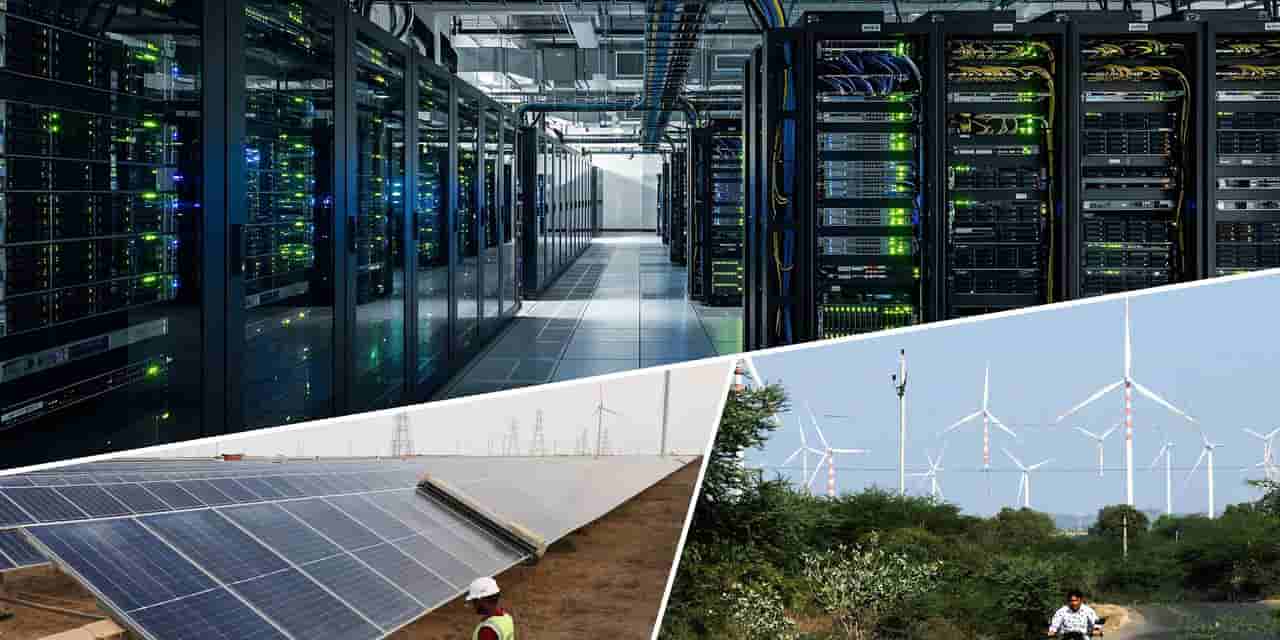
India's rapid expansion of data centers, driven by its ambition to become a major hub for artificial intelligence and digital services, is creating a substantial demand for electricity. This surge in energy needs is transforming the renewable energy sector, as companies are increasingly willing to sign long-term power purchase agreements for solar and wind projects to ensure a reliable and sustainable energy supply.
Data center capacity in India is projected to nearly triple from 870 MW in 2023 to over 2,500 MW by 2030, attracting over $10 billion in planned investments from both domestic players like AdaniConneX, Yotta Infrastructure, and CtrlS, as well as global hyperscalers such as AWS, Google, and Microsoft. By the end of the decade, these facilities are expected to consume 5 to 6 gigawatts of power, a significant portion of the country's total electricity needs, estimated at 3% by 2030.
This escalating energy demand presents a challenge, especially given that approximately 70% of India's current electricity generation comes from coal. However, it also presents an opportunity for renewable energy. India has ambitious goals to increase its renewable capacity to 500 GW by 2030, and the long-term contracts offered by data centers can enhance the bankability of new solar and wind projects. Investment giant Brookfield views this convergence of digital infrastructure and renewable energy as a central theme for India's next investment cycle, where power availability is becoming as critical as computing capacity.