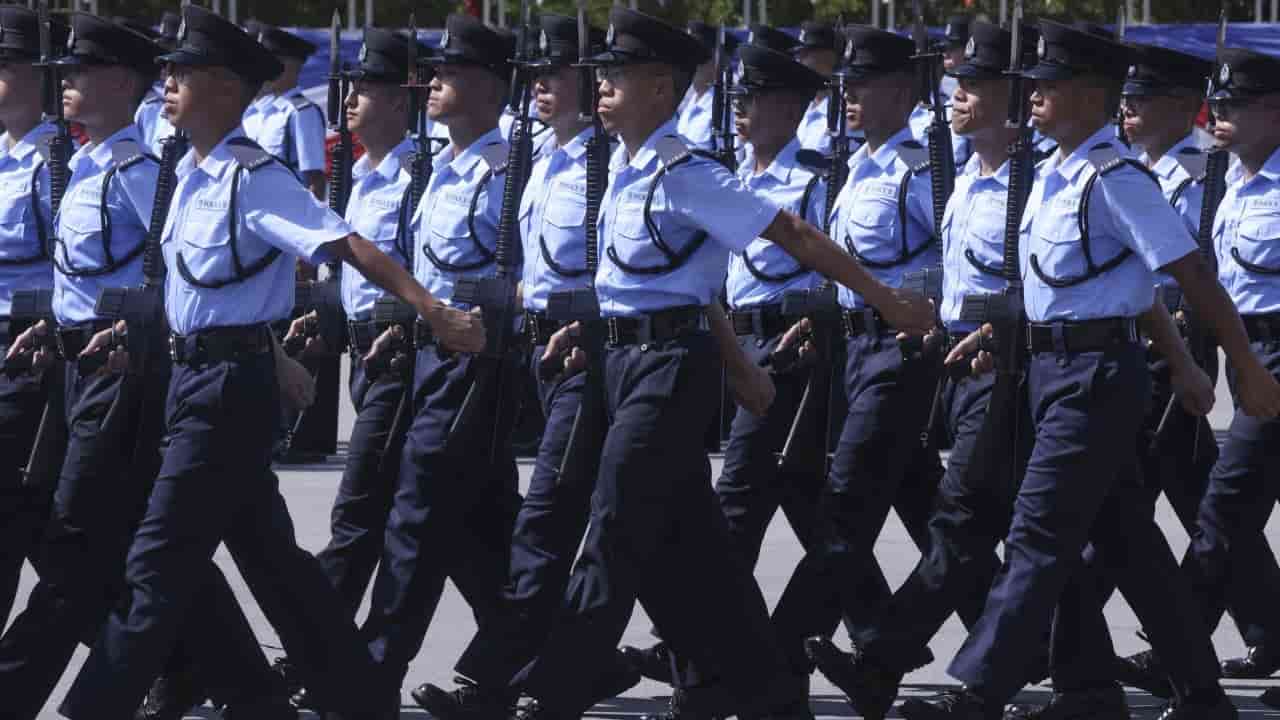
Hong Kong police will launch the Hong Kong International Academy of Policing on November 11 and a new bachelor's degree program in March, aiming to enhance officer skills and foster international cooperation. The degree program, accredited by the Hong Kong Council for Accreditation of Academic and Vocational Qualifications, will be fully funded by the force for eligible officers.

The initiatives aim to elevate the professional standards of Hong Kong police officers, enhance their analytical and investigative skills, and bolster the force's international standing and cooperation in security matters.
Hong Kong police are set to launch the Hong Kong International Academy of Policing on November 11, aiming to create an international professional policing exchange platform. Concurrently, the Hong Kong Police College will introduce a new bachelor's degree program in March, making it the first government department approved to award such a degree.
The International Academy of Policing, according to Kelly Cheng Lai-ki, director of the Police College, will serve as an international exchange hub, consolidating frontline policing wisdom and promoting mutual learning. It will coordinate over 20 key training courses and host policing leadership forums on topics such as major event security, crowd management, major crime investigation, forensic science, and cybercrime investigation. Fu Yee-ting, principal of the School of Professional Development, stated the academy aims to enhance the Force's effectiveness and strengthen overseas cooperation.
The Bachelor of Policing (Honours) (Security and Criminal Investigation) programme has received accreditation from the Hong Kong Council for Accreditation of Academic and Vocational Qualifications. This program is designed for rank-and-file officers who do not hold a bachelor's degree, with about 40% of recent recruits already possessing a degree or higher. Cheung Hoi-yan, principal of the School of Specialised Learning, explained that the program will recruit at the end of the year and commence in March. It offers junior and senior entry routes, admitting over 80 and 40 students annually, respectively. The curriculum is taught bilingually and covers policing theory, criminal investigation, practical training, academic language, and a graduation project. Officers enrolled will receive full funding from the Force, with a requirement to sign a service undertaking for at least two years post-completion or compensate training costs.
Pick the topics you care about. Get only what matters, on your cadence.